
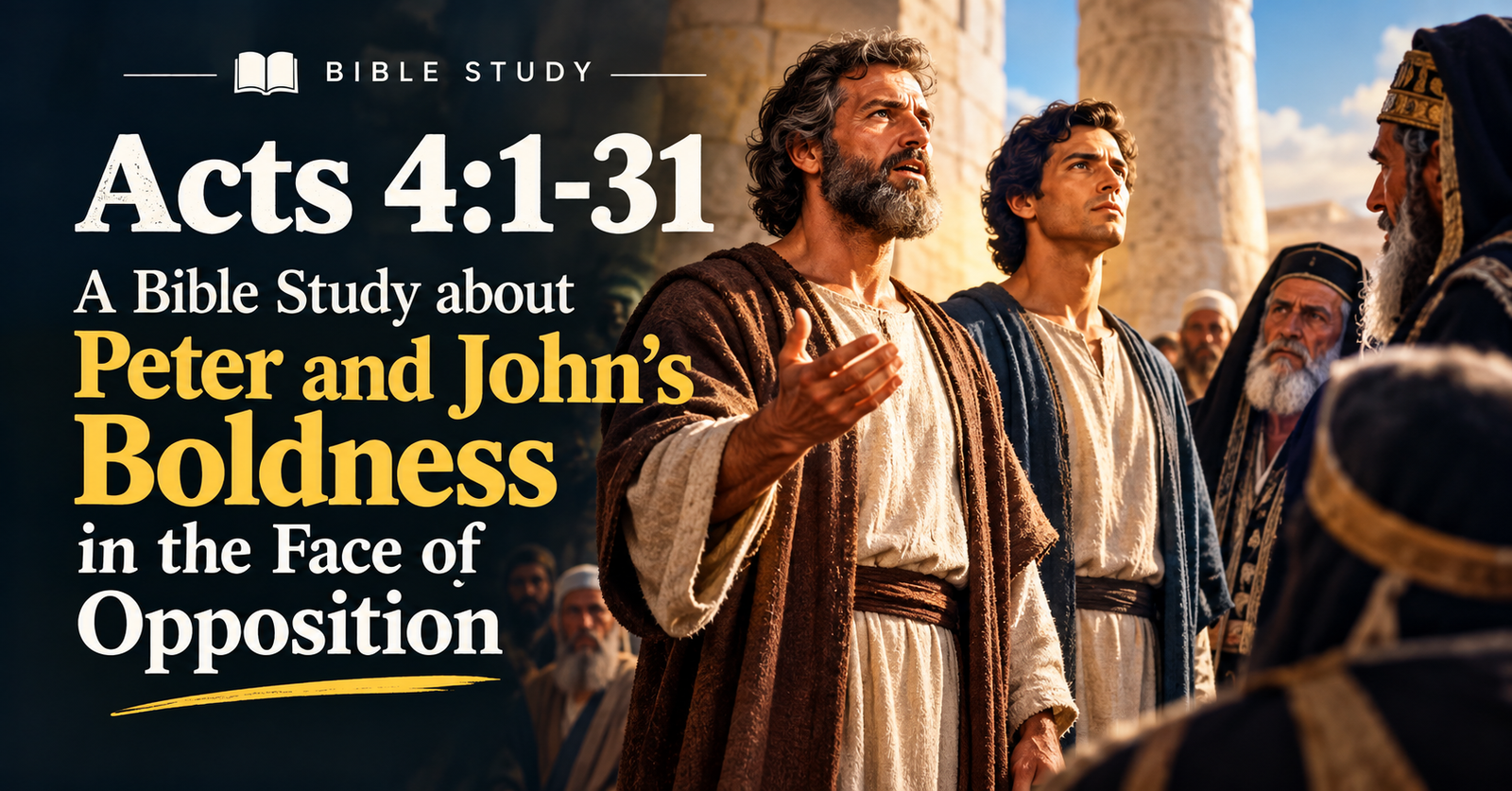
Picking up right where our last Bible study left off, I still get a little excited retelling this part to my group. We had just watched Peter and John carry out a miraculous healing of a lame beggar, and then stood by as they started addressing the crowd of astonished onlookers who couldn’t quite believe what they’d seen. It’s one of those moments where I always pause and ask my study group to imagine actually being there, watching a man who couldn’t walk suddenly jumping around in front of everyone.
In this upcoming study, we’re going to walk through the culmination of that whole event – what happened next, and how Peter and John responded when the religious leaders pushed back on them. Before we dive in, I always point my group toward the Printable Discussion Questions, which make for a great way to work through this passage together, along with All Resources from Acts if anyone wants to go deeper into the wider story.
I always find this next part of the story a little ironic, honestly. Right when things should have been celebrated, the religious authorities got involved, and according to Acts 4:1-4 in the ESV, the priests, the captain of the temple, and the Sadducees came upon Peter and John while they were still speaking to the people. They were annoyed – the passage even says dissatisfied – because Peter and John were teaching the crowd and proclaiming in Jesus the resurrection from the dead. The teachings these two men shared went directly against what the Sadducees believed, and rather than engage honestly, the religious establishment simply wanted to suppress them. So they arrested Peter and John and threw them into custody until the next day, since it was already evening.
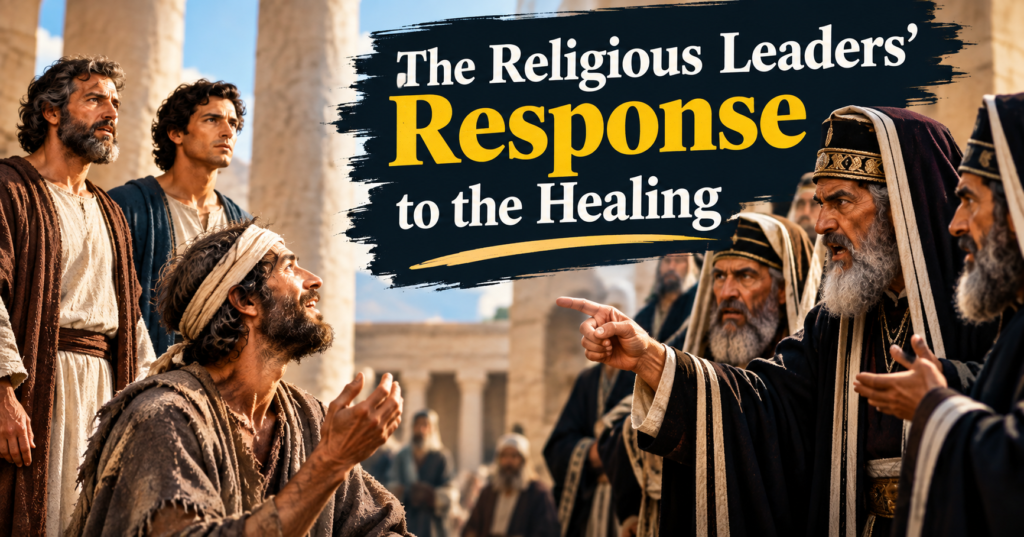
What strikes me every time I teach this is how the religious leaders simply couldn’t compete. The wisdom of the Holy Spirit working through these devout disciples of Jesus clearly surpassed any human intellect these leaders relied on, leaving them genuinely uncertain how to even discipline Peter and John. And despite the arrest, the word still spread – many who heard it believed, and the number of men alone grew to about five thousand. That detail always gets me; even opposition and jail couldn’t stop what God was doing through them.
I’ve noticed that most people, myself included, tend to shrink a little when someone in authority puts them on the spot — but that’s not what happened when the religious leaders dragged Peter and John in and questioned them about healing a lame man in the temple courts. They didn’t stammer or backpedal; they looked straight at the council that had crucified Jesus weeks earlier and said his name anyway, calling him the Son of God without flinching. What made this possible, the text is clear, was that Peter was filled with the Holy Spirit in that very moment, and it’s that filling — not personal grit — that produced such raw courage. Their testimony stayed steadfast even though everyone in that room had the power to make their lives very difficult.
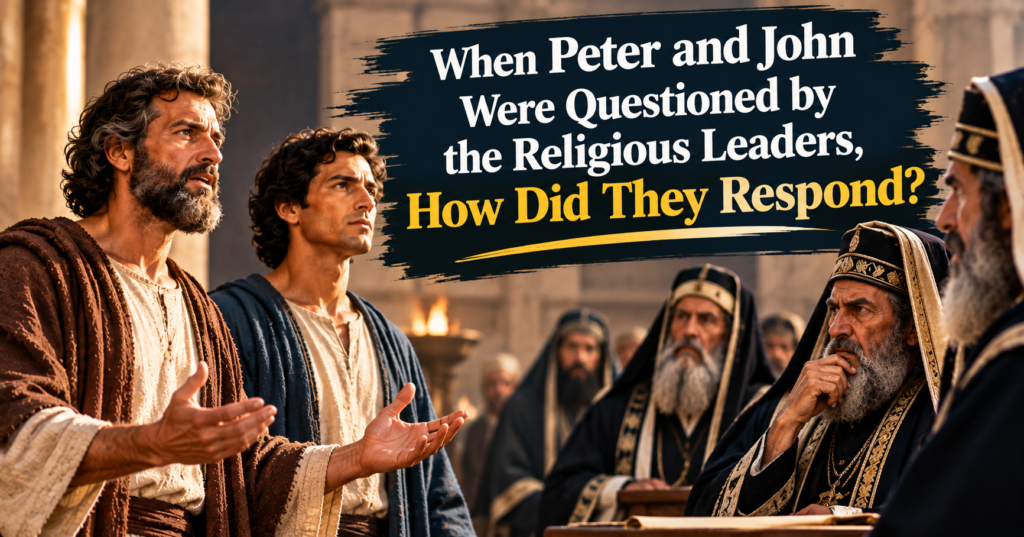
I think about this scene whenever I’m tempted to soften what I believe to avoid an awkward conversation, because Peter and John clearly understood the potential consequences of what they were saying and answered honestly anyway. Their response wasn’t reckless fearlessness for its own sake; it was conviction born from trust that their calling came from somewhere higher than the council’s approval. Real persecution was on the table, yet opposition couldn’t deter them from the mission they’d been given, and there’s genuine comfort in knowing their boldness came wrapped in faith, not bravado. That kind of persistence under pressure is something I still find myself praying for in my own life.
Something I always point out in Bible study is that Peter wasn’t naturally the calm one — this is the same man who denied knowing Jesus three times under far less pressure, yet here he stands before the council with an inspired speech that doesn’t sound like him at all. The only explanation Scripture gives is God’s presence working through him: Luke says he was filled with the Holy Spirit in that exact moment, and that spiritual empowerment is what turned his directed words into something bigger than his own nerve could produce. Alongside John, he answered with a boldness that had nothing to do with confidence and everything to do with divine guidance taking over where his fear would normally have won.
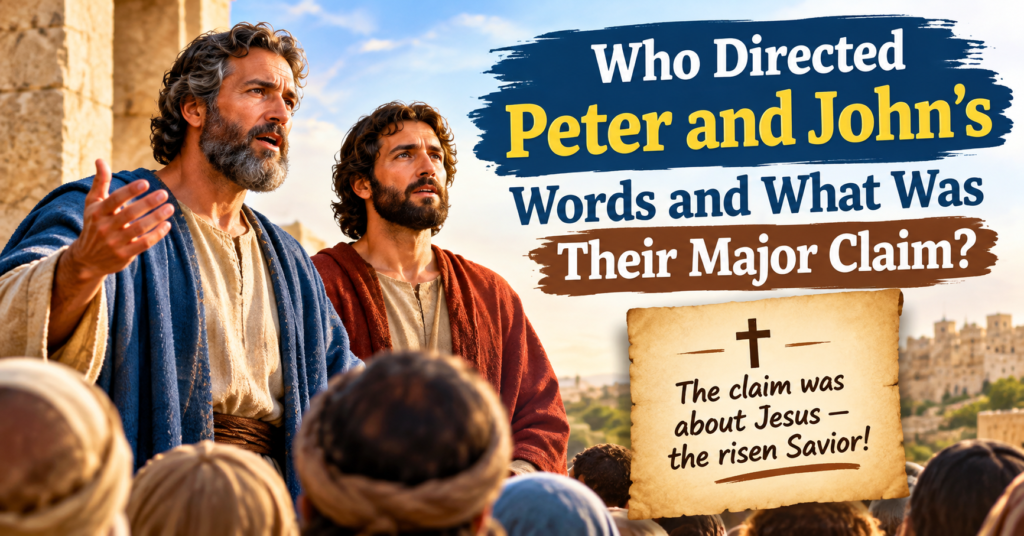
Their major claim — really the only claim that mattered to them — was that the man they watched die at the crucifixion, the one these same leaders had condemned, was in fact the Son of God and the sole source of salvation for anyone willing to believe it. I find that kind of steadfastness genuinely moving, because it means their testimony wasn’t shaped by the room they stood in but by what they’d actually witnessed. Whenever my own faith feels shaky, I go back to this passage for comfort, remembering that conviction like theirs was never self-generated — it was given, and it still is.
Acts 4:12 – A Bible Memory Verse
There’s one verse from this chapter I keep taped inside my Bible cover, and it’s worth treating as a genuine Bible Memory Verse: “There is salvation in no one else, for there is no other name under heaven given among men by which we must be saved.” Peter said this fearlessly in front of the same council that had overseen the crucifixion, and he spoke as one of the eyewitnesses who’d since watched the resurrection and ascension happen right in front of him — that’s not secondhand belief, that’s a confident claim rooted in what he personally attained through witness. He and John were undaunted by physical threats, because their calling had been safeguarded by something no council could touch, and the healing power they’d just displayed on a crippled man was proof that the power of God was still very much active.
I’ve sat with these verses long enough to use them as Reflection Questions in my own quiet time, asking myself whether my faith is as secure as Peter’s or if it bends under pressure. What he proclaimed that day wasn’t a private opinion; it was salvation through Jesus offered to the whole world, meant for every soul willing to receive it, and that includes the souls of people who never expected good news to reach them. I think of the early missionaries who carried this same message across oceans with nothing but that verse and real joy driving them forward, and it reminds me that the courage to heal and to speak was never about having it all figured out — it was about trusting the name that had already proven itself sufficient.
Every time I read these verses, I can’t help but think about where the story of the apostles actually leads — a handful of disciples speaking to one crowd in Jerusalem, and centuries later that same spiritual empowerment has reached every corner of the earth. So here’s a question I like asking my own faith community: if you were a missionary sent out today, which continent would you choose, and why? It’s not a small thing to consider, because sharing the gospel was a daunting task even for people empowered by the Holy Spirit himself, and Peter and John faced real religious leaders who wanted them silenced before they’d said a word.

I’ve asked this in small groups before, and the answers always reveal something honest about people’s own doubts or hopes — some Christians picture themselves in a busy city doing evangelism door to door, others imagine quiet villages that have never once heard the words of the New Testament. What I remind everyone is that gospel outreach was never promised smooth acceptance, not for the first believers and not for us either, yet that hasn’t stopped faithful people from going anyway. So take a minute and actually picture it: pick your continent, picture the faces, and ask yourself if you’d have the same resolve those early witnesses did.
1 Corinthians 12:13 (ESV)
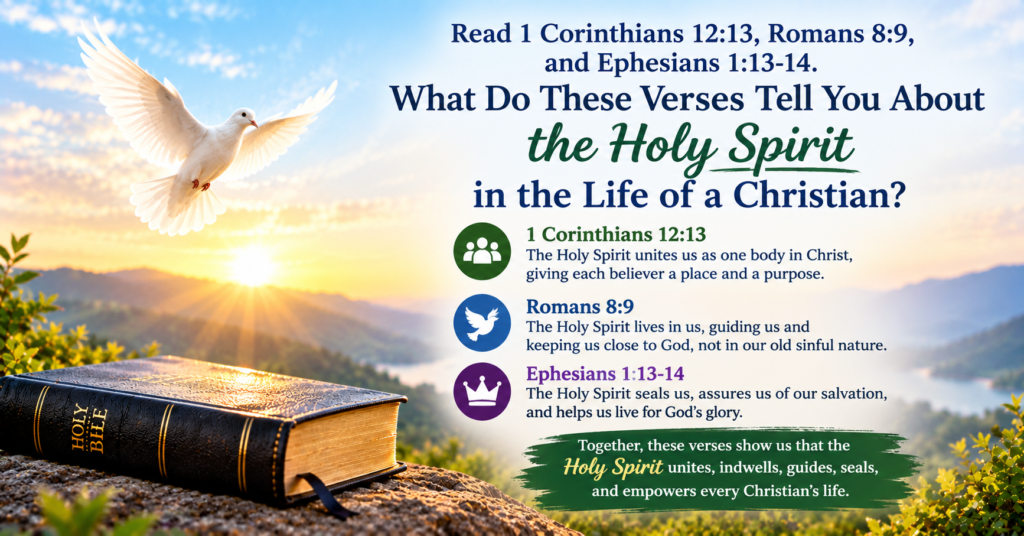
Reading Acts 4 always sends me back to another verse I love, “For in one Spirit we were all baptized into one body — Jews or Greeks, slaves or free — and all were made to drink of the Spirit.” That’s Paul describing one Spirit forming something Peter and John were already living out in the temple courts: a church body built on spiritual unity, not on background or status. I think that’s part of why their boldness landed the way it did — the fellowship growing around them wasn’t limited to people who looked or sounded alike, it was oneness in Christ pulling together people who never would have shared a table otherwise.
I’ve experienced this firsthand in churches that felt more like a patchwork than a club, and honestly those have been the healthiest ones I’ve belonged to. This kind of unity isn’t something a group manufactures through good manners; it’s produced by the same Holy Spirit who filled Peter that day in front of the council, and that’s exactly what makes real inclusiveness possible rather than just polite tolerance. Whenever I doubt whether that kind of togetherness is realistic, I remember this verse says it plainly — it already happened once, and it can happen again.
Romans 8:9 (ESV)
There’s a verse in Romans that helps explain why Peter’s boldness before the council wasn’t a one-time fluke: “You are not in the flesh but in the Spirit, if in fact the Spirit of God dwells in you. Anyone who does not have the Spirit of Christ does not belong to him.” That word “dwells” always catches me — it’s not a visit, it’s residence, an indwelling Spirit that settles in permanently rather than showing up only for dramatic moments like the one in the temple courts. Peter didn’t borrow courage for that afternoon; he was already carrying the Holy Spirit presence that had marked him since Pentecost, and that’s the same presence Paul says defines who actually belongs to Christ at all.
I think about this a lot when I feel spiritually dry, because this verse isn’t really about performance, it’s about spiritual identity. My relationship with Christ doesn’t hinge on whether I feel bold on a given day; it rests on whether the Spirit still dwells in me, and Scripture says he does. That ongoing process — what theologians call sanctification — is really just the Spirit working out in daily life what was already true the moment he moved in. Peter and John are proof that this isn’t just doctrine on a page; it’s what actually produces the kind of steady conviction that can face down a hostile council and not blink.
Ephesians 1:13-14 (ESV)
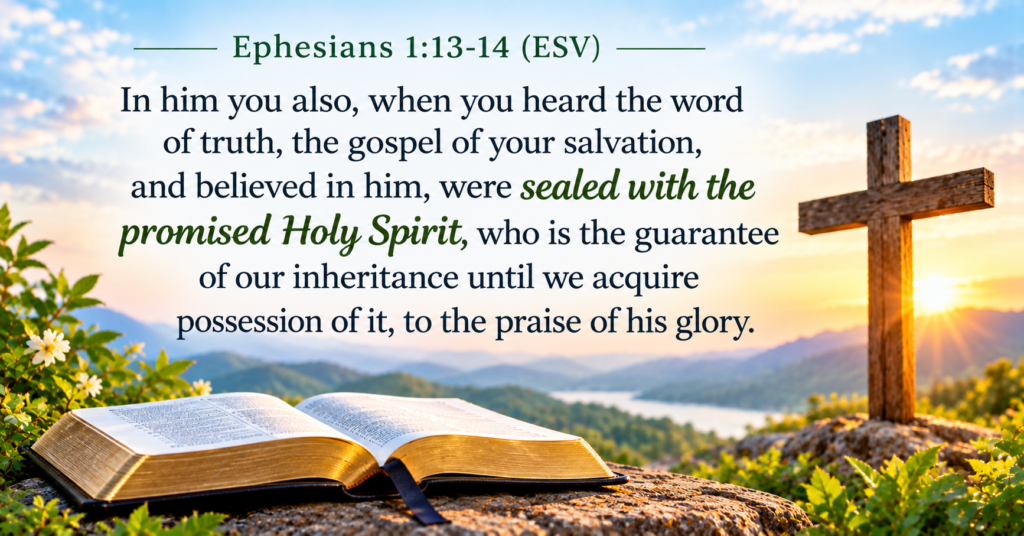
Paul’s words to the Ephesians always feel like the quiet backstory to what happened in Acts 4: “In him you also, when you heard the word of truth, the gospel of your salvation, and believed in him, were sealed with the promised Holy Spirit, who is the guarantee of our inheritance until we acquire possession of it, to the praise of his glory.” That sealing isn’t decorative language — it’s the same Spirit that filled Peter in front of the council, marking him as genuinely belonging to Christ long before he opened his mouth to speak. I find it remarkable that Paul ties this sealing directly to redemption, as if the Spirit’s presence is proof, not just promise, that the transaction was already settled.
I hold onto this passage whenever my own faith in Christ feels uncertain, because it hands me real assurance of salvation instead of a hope I have to manufacture myself. The Spirit functions like a down payment on an eternal inheritance, guaranteeing that what’s been started will actually be finished — which is exactly the kind of confidence that let two ordinary fishermen stand fearless before a hostile council. Their boldness wasn’t borrowed optimism; it flowed from knowing the guarantee was already sealed in them, the same guarantee available to anyone who believes.
Put these three passages together and a pattern emerges that’s honestly bigger than any single moment in Acts 4: the Holy Spirit doesn’t just show up for dramatic scenes in front of hostile councils, he’s present for the slow, ordinary work of guiding a Christian through everyday spiritual growth. I think about my own faith journey, which started with my grandma tucking a Bible cover into my hands in high school, long before I understood what any of it meant. I drifted away for a while in college, distracted and unconvinced, until a chance conversation at a Freshman Activity Fair left me strangely convinced there was more to explore, and looking back I can only call that nudging the same Spirit these verses describe.
What strikes me is how patient that process was — real patience, not pressure, the Spirit’s quiet guidance working on God’s timing rather than mine. Getting sealed, being baptized into one body, having the Spirit dwell within: these verses show that once you belong to Christ, that presence commits to walking with you toward faith renewal even after seasons of doubt. A local church and honest Christian fellowship became the setting where that happened for me, through encouraging friends and a season of spiritual mentorship that felt less like instruction and more like commitment to actually being there. Even now, when I’m speaking to someone about their own life of faith, I try to remember that God rarely rushes this — the same Spirit that emboldened Peter and John is the one still quietly shaping every ordinary believer’s story, word by words, one patient step at a time.
Have You Ever Felt the Power of the Holy Spirit in Your Words or Actions, or Someone Else’s? Is There an Area of Your Life Where You Could Use His Help?
Peter and John got a dramatic, unmistakable spiritual experience — healing a man’s legs and then speaking boldly to a hostile council — but most of my own encounters with the power of the Holy Spirit have looked far quieter than that. I remember my grandmother calling me out of nowhere one afternoon, just to check in, on the exact day I’d been struggling with something I hadn’t told a soul; that kind of nudge doesn’t announce itself, but I’ve come to recognize it as part of my own faith journey. Not every experience with the Spirit comes with immediate results or tangible outcomes you can point to right away — sometimes it’s just a small prompting toward forgiveness you weren’t ready to offer, or words that come out of your mouth kinder than you planned, or actions that surprise even you in the moment.
Thinking about this honestly, there’s an area of my own life — patience with people who’ve hurt me, mostly — where I know I still need the Spirit’s help rather than trying to muscle through it on willpower. I’ve started praying for that specifically, not expecting a lightning-bolt answer but trusting God’s timing the way Peter and John clearly did, extending something like an olive branch even to people who don’t deserve it yet. If you’re in a similar spot, I’d genuinely encourage sitting with that same question in prayer, asking plainly for his assistance and then giving it the same patience this whole passage keeps circling back to — because the Spirit rarely rushes, but he does show up.
Acts 4:23-31 (ESV)
When Peter and John were released, they didn’t go home to rest; they went straight to their friends and reported everything the chief priests and elders had said, and the believers who heard it responded by lifting their voices together to God as Sovereign Lord, the one who made heaven, earth, and sea. They quoted David, recognizing that the Holy Spirit had spoken through him long before, predicting how Gentiles and peoples would rage and kings and rulers would plot against the Lord’s Anointed. That prophecy had already played out exactly as predestined: Herod, Pontius Pilate, the nations, and the people of Israel all gathered together against Jesus, God’s holy servant, whom he anointed — proof that even the worst opposition was somehow folded into God’s larger plan.
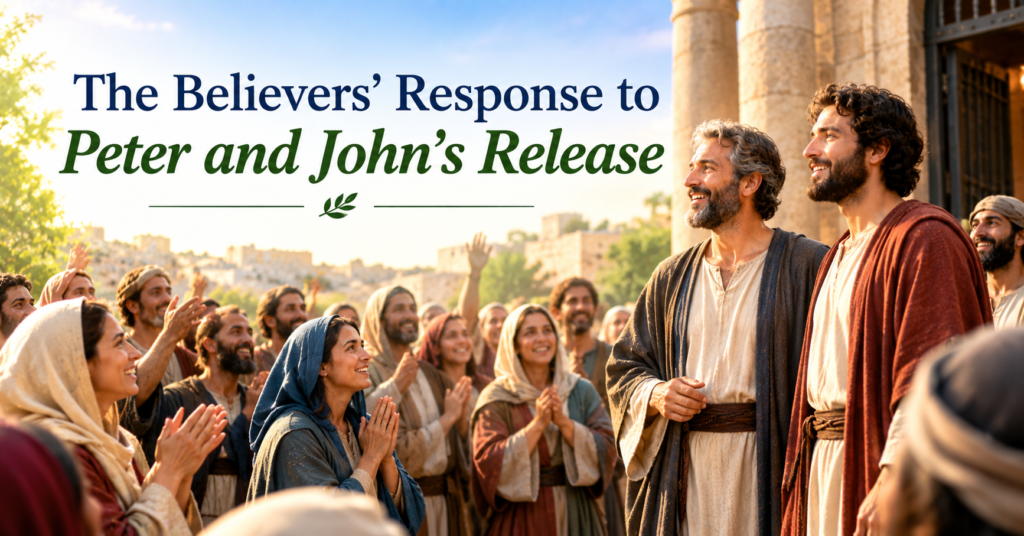
What moves me most is what the believers actually asked for. Rather than praying for the threats to stop, they asked God to look upon them and give his servants the boldness to keep speaking his word, while he continued to stretch out his hand to heal and perform signs and wonders through the name of his holy servant Jesus. As they prayed, the place where they were meeting was literally shaken, and they were all filled with the Holy Spirit and began speaking the word of God with boldness. I’ve never had a room physically shake when I’ve prayed, but I’ve felt that same unmistakable shift in courage after real prayer, and it’s humbling to realize this pattern hasn’t changed in two thousand years.
Discussion Question #10: How Did the Believers Respond to Peter and John’s Release?
The encouraging response here says a lot about what real Christian community looks like under pressure. The moment Peter and John walked free, they didn’t scatter to process it alone; they went straight to their friends and reported every detail of what the chief priests and elders had threatened them with. What happened next wasn’t panic or strategy sessions about how to avoid future trouble — the believers simply gathered together in unity, choosing shared fellowship and prayer over fear.I think that instinct is worth noticing, because it wasn’t obvious or automatic. Most people, when they hear a friend was just interrogated by powerful officials, respond with worry or caution — but this group’s first move was collective worship. Their way to respond to that kind of release wasn’t relief followed by silence; it was turning immediately toward God together, which tells me their sense of community ran deeper than mutual comfort. It was built on something sturdier than convenience.
Discussion Question #11: What Did the Believers Pray? What Was the Answer from God?
What the believers prayed for still surprises me every time I read it. They didn’t ask God to remove the rulers who’d threatened them or to make the danger disappear; they asked for boldness and for power to keep doing exactly what had gotten Peter and John arrested in the first place. Their requests leaned entirely on trusting God’s omniscience, referencing David‘s words as evidence that God had already seen this opposition coming — he didn’t need anyone to predict what would happen because he’d known it all along, down to the exact speech and actions of the people involved.The answer from God came almost immediately and unmistakably: the ground beneath them was shaken like a small earthquake, and everyone in that room was filled with the Spirit and began speaking with words of boldness. I don’t think that’s a coincidence or theater — it reads to me like God confirming, in a way nobody could misread, that the very thing they’d asked for had already been granted. There’s something clarifying about a prayer answered that specifically and that fast.
Discussion Question #12: Describe a Time When You Prayed to God and Received an Answer. What Do You Need to Pray For Now?
I can tell you about my own immediate need moment, back in college when money was running short to the point of real stress, and I remember sitting with that fear instead of doing anything productive about it. Then a check showed up in the mail from my aunt, who had no way of knowing what I was dealing with — I was genuinely shocked, and looking back I still call it a huge answer to prayer, the kind that made me understand a little of what the disciples must have felt when their own prayers got answered so visibly.That experience taught me something about the natural reaction most of us have toward confrontation or hardship — the instinct to feel fear, to cower, or even to give up before giving prayer a real chance. But scripture keeps pushing me to acknowledge God’s power as creator of the entire world, the same Holy Spirit who moved so tangibly in my past proving his omniscience was never in question — he knew what I needed before I asked. The result wasn’t as dramatic as an earthquake, but it gave me a small taste of that same boldness, and it’s why I still believe he can act immediately and visibly when he chooses; I need to keep bringing him my own request in prayer and trust that he still answers prayer even when I can’t see how yet.