
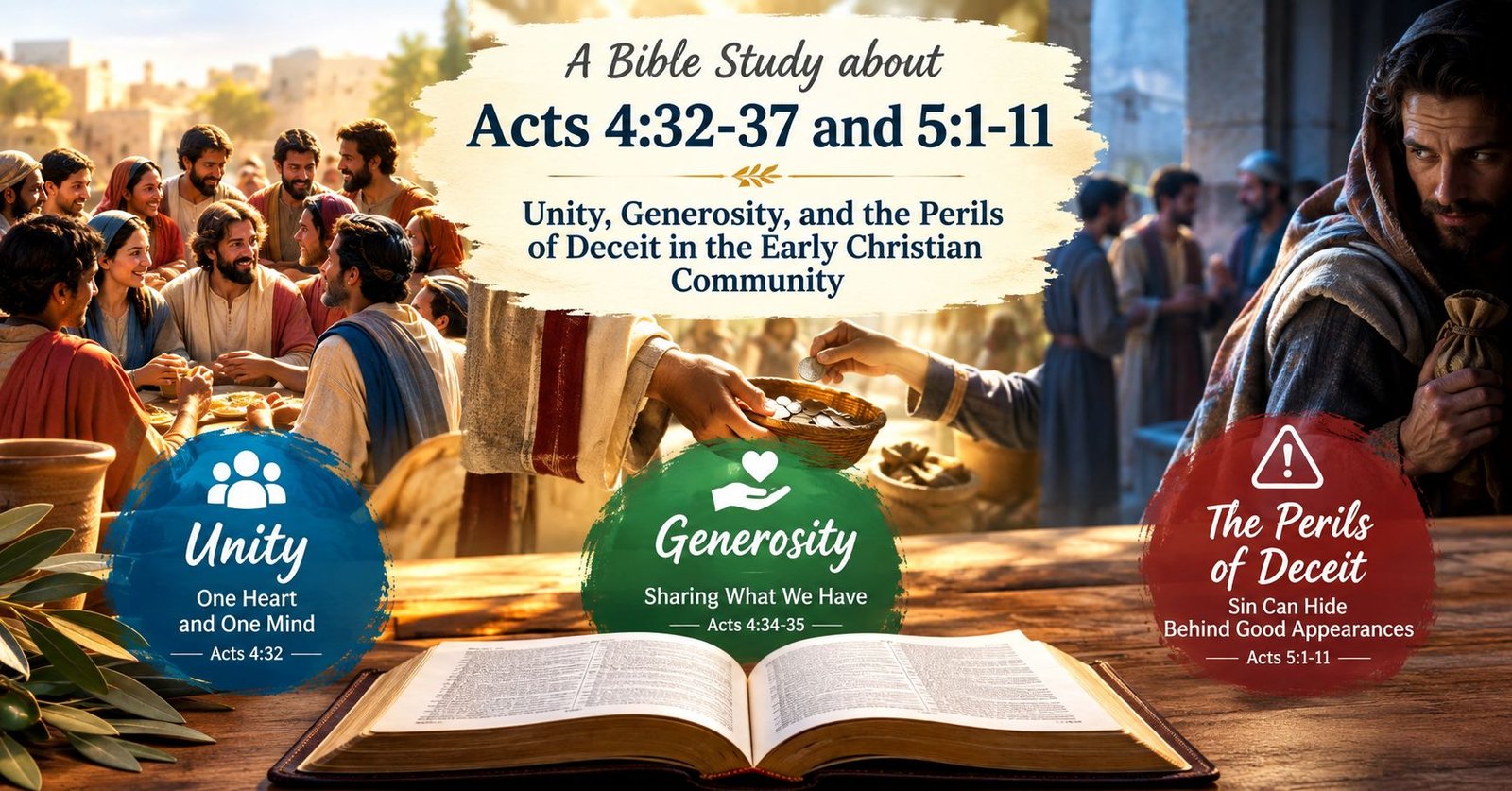
This Bible Study walks through Acts 4:32-37 and Acts 5:1-10, six simple discussion prompts that carry you from the good news of unity and generosity in the early Christian community straight into a hard lesson on honesty. We open with Discussion Question #1, asking what One in Heart and Mind really looked like for the believers, then move to Discussion Question #2 on their shared values and Discussion Question #3 on how those same principles and priorities still shape modern Christian communities today. From there we turn to Ananias and Sapphira, and I still remember the first time I read their story and felt a genuine chill – Discussion Question #4 asks you to name their actions and motives, Discussion Question #5 asks why God responded to their deceit the way He did, and Discussion Question #6 pulls out the lessons on integrity and the fear of God. You’ll also find a full Table of Contents to jump around, a Downloads section, a place to Respond with your own thoughts, and a list of Related Resources if you want to sit with this story of Deception a little longer.
I still keep the ESV open next to my coffee whenever I sit down with these passages, because Acts 4:32-37 and Acts 5:1-11 never stop feeling personal to me. These scriptures and their inspiring verses lay the foundation for what a faithful community, a strong community, a truly united one of the Christian communities can look like, and they ask us to reflect on the significance of personal integrity and genuine reverence for God. The early Christian community shared everything from its shared values to its daily priorities, and that same spirit still carries profound insights and valuable lessons that can enrich our lives today. But the story doesn’t stay warm forever – it turns into a cautionary tale about dishonesty, deceit, and the consequences that follow, and that’s exactly why these principles still matter. If you want to go further, this Bible study links out to Printable Discussion Questions and All Resources from Acts over at joyfulmomentsinchrist.com.
Acts 4:32-37 – One in Heart and Mind
Every time I open Acts 4:32-37 in the ESV, I get a small glimpse of what real faith looked like in the early Christian community, and honestly, it still humbles me. The believers were one heart and soul, a tightly-knit family bound by genuine unity rather than division or selfishness. This scriptural account shows their shared values and priorities in action – owners of lands and houses sold what they had, and the proceeds were distributed to any needy person among them, no questions asked. Take Joseph, a Levite, a native of Cyprus, whom the apostles renamed Barnabas, meaning son of encouragement – he sold a field and laid the money at the apostles’ feet, just like so many others who treated their possessions as common property.
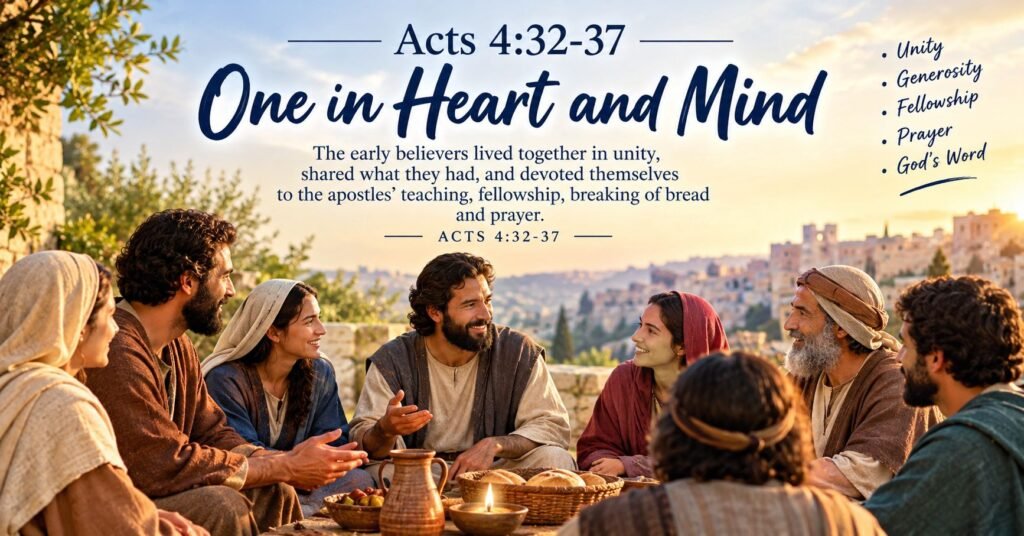
What strikes me most, and what I try to remember every time I study this passage, is that this wasn’t forced generosity. It flowed from an unwavering commitment to Jesus Christ and a deep spiritual connection that ran through the whole group. The apostles gave their testimony to the resurrection of the Lord Jesus with great power, and great grace rested on everyone who believed. This kind of material sharing wasn’t about rules; it grew naturally out of living and sharing life together, following the teachings of Jesus with unwavering commitment and real generosity.
Discussion Question #1: Describe the unity and generosity of the early Christian community.
Whenever I sit with this question in a small group, someone always pauses at the phrase one heart and soul, and I love watching that moment click for them. The early Christian community wasn’t just a crowd of people who happened to share a building – they were a closely-knit family, and their remarkable unity grew out of a faith in Christ that ran far deeper than simple acquaintanceship. That word soul is interesting too; it’s sometimes translated as mind, which tells me their unity wasn’t only emotional, it touched how they thought and reasoned together. This wasn’t a shallow bond – it transcended the usual limits of friendship and became something closer to deep spiritual unity.
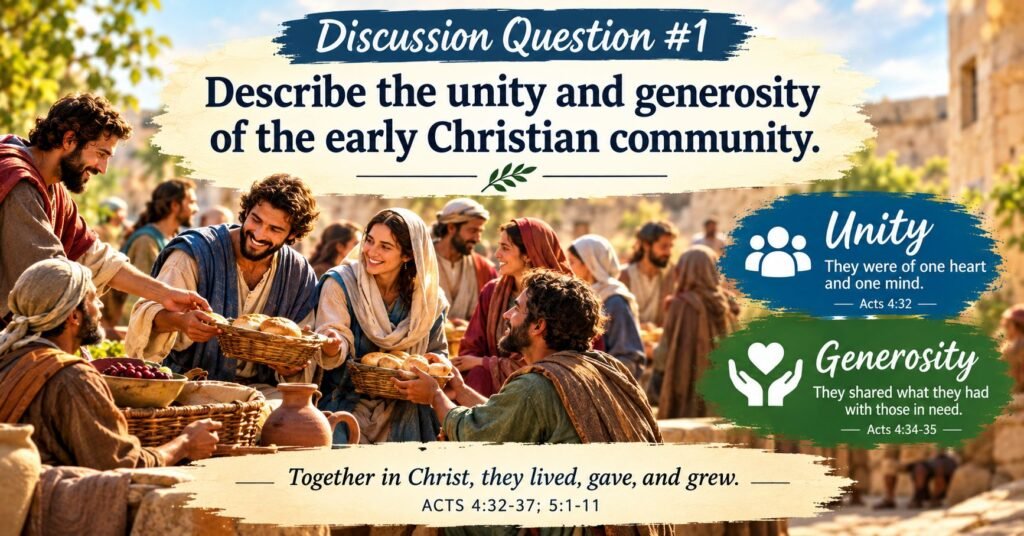
What really gets me, every time I teach on this, is how their generosity worked. They held possessions in common, practiced real material sharing, and set aside individual interests for the good of the collective. This was selfless, Christ-centered unity in its purest form, born out of genuine commitment to following Jesus and to one another. Their extraordinary care for the needs and well-being of their fellow believers wasn’t an accident – it was the natural fruit of putting Christ and Jesus at the center of everything they did.
Discussion Question #2: What do we learn about their shared values and priorities?
I always tell my study group that Acts 4:32-27 gives us an uncommon display of what a church can look like when it actually lives out its faith. The early Christian community built its shared values on the teachings of Jesus, and that meant love, selflessness, and a deep concern for the well-being of their fellow believers came before anything else. It wasn’t abstract theology either – they were taught to care for their neighbors as themselves, and that showed up in real, deliberate steps rather than empty talk.

What I find most convicting, honestly, is that their top priorities never centered on wealth or accumulation of resources. Instead, the welfare of the whole community came first, and they worked toward an equitable distribution so that no member was left in need. Their genuine care and collective welfare weren’t just nice ideas – they were commitment in action, and that’s why this passage still stands as a powerful reminder for Christian communities today. It speaks to the enduring significance of collective care within the body of Christ, and honestly, the importance of these values hasn’t faded at all throughout history.
Discussion Question #3: How can these principles apply to our modern Christian communities?
I get asked this a lot in Bible study: does communal living like we see in Acts even make sense today? Honestly, most modern living arrangements look nothing like the early Christian community, and most of us aren’t pooling our possessions the way those early believers did. But the deeper common bond of faith behind it all hasn’t gone anywhere. Whether it’s congregations, home churches, or small groups, modern Christian communities can still be implemented around the same shared values – unity, generosity, and mutual support. I’ve seen small groups pool shared resources, not just money but time, talents, and skills, through pooling resources for real communal projects that help real people.What strikes me most is how naturally the rest follows. Fellowship and support show up when believers start praying for one another and offering emotional support through joy and challenge alike. The spirit of generosity shows up in charitable initiatives, volunteering, and simply helping a neighbor in need, reaching less fortunate people both inside and outside the Christian community. Stewardship matters too – remembering that everything belongs to God means practicing responsible stewardship of financial resources for the common good and in line with God’s purposes. And maintaining unity means resolving conflicts and working toward common goals in a harmonious manner. When we hold onto this commitment, our churches still carry the teachings of Christ, becoming a source of inspiration and transformation for believers and the world.

Every time I teach this part, the room goes quiet, because Acts 5:1-11 is such a stark contrast to the beauty we just saw in Acts 4:32-37. That same vibrant Christian community built on shared values, early Christian unity, and generosity had members who were tempted by something darker. Ananias and his wife Sapphira sold a piece of property, but out of a hidden desire for admiration, they succumbed to the allure of personal gain and kept back part of the proceeds for themselves. It wasn’t about the money itself – it was a quest that cost them the virtue of honesty. When Peter confronted Ananias, he asked plainly why Satan had filled his heart to lie to the Holy Spirit, pointing out that the land had been his own while unsold, and remained at his disposal even after it was sold. The deceit was contrived in his heart with full knowledge, and Peter made it clear this deed wasn’t a lie told to man but to God.What happened next still gives me chills whenever I read it aloud. Ananias breathed his last the moment he heard those words, and great fear swept over everyone who heard of it – the young men came in, wrapped him, carried him out, and buried him. About three hours later, an interval that must have felt endless, his husband‘s fate unknown to her, Sapphira came in. Peter put her to the test, asking if the land was sold for that part of the price, and she repeated the same lie. He told her she had agreed together to test the Spirit of the Lord, and that the feet of the young men who buried her husband were already at the door. She too fell and breathed her last, found dead by the same young men, and buried beside her husband. This story of cautionary tale and deceit, right there at the apostles’ feet, left great fear on the whole church.
Discussion Question #4: Describe Ananias and Sapphira’s actions and motives.
Whenever I walk a group through this narrative, I put the spotlight right on Ananias and Sapphira, because their actions and motives are really the heart of this cautionary tale. The Acts 5:1-11 account describes a troubling incident where they hatched a deceitful scheme: they sold a piece of property, but conspired to withhold a portion of the proceeds while pretending to hand over the entire amount to the community. I always pause here to ask my group what they think the real motive was, and it usually comes down to one thing – a desire for personal admiration and acclaim. They wanted the illusion of extraordinary generosity without actually giving it, quietly retaining what they’d agreed to give away.
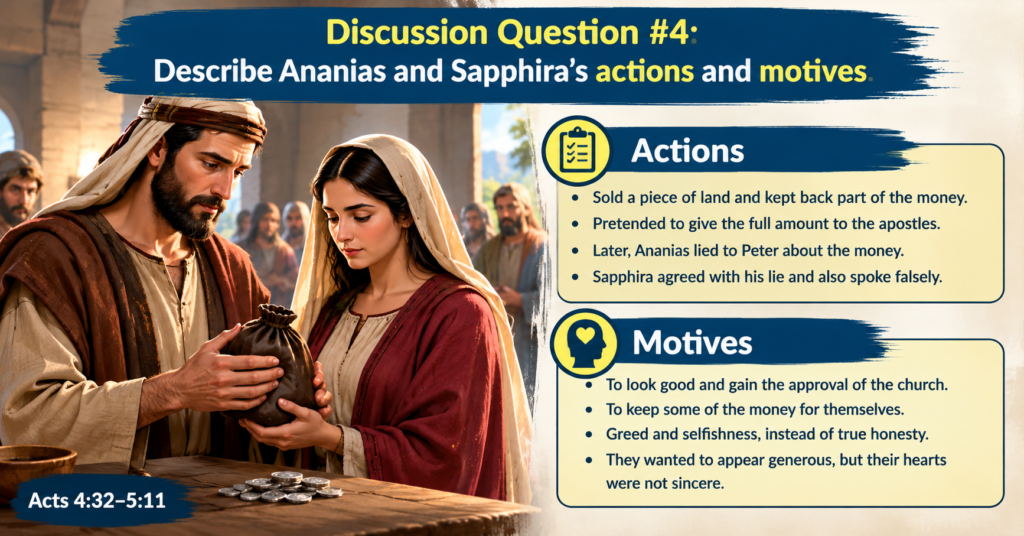
To me, this passage works as a stark reminder of the potential pitfalls hiding inside any close-knit community, even one built on faith and fellowship. It shows how quickly personal motives can overshadow shared values, unity, honesty, and integrity that once defined the early Christian church. Ananias and Sapphira’s story teaches us the delicate balance required to protect these principles, reminding every generation of believers just how fragile that balance really is.
Discussion Question #5: Why do you think God responded as He did to their deceit?
This question always sparks the liveliest debate in my group, because on the surface God‘s punishment of Ananias and Sapphira feels genuinely harsh. But once we dig into Acts 5:3, using it almost like a Bible Memory Verse with a few Reflection Questions to guide us, the picture changes. Their sinning wasn’t really against the community at all – it was against the Holy Spirit, and that distinction changes everything. Their actions undermined the trust and unity within the early Christian community, and quietly chipped away at the integrity of their faith.
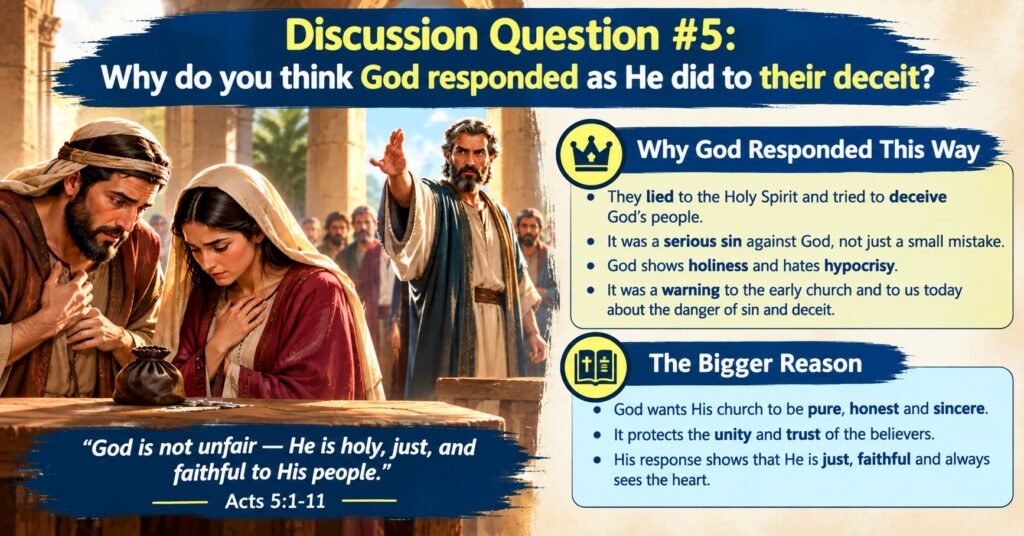
Here’s what I always point out: it would have been completely fine for them to hold back a portion of their proceeds. Nobody was forcing them to give it all. The real problem was that they wrapped their gift in false piety and devotion to both God and the community, when neither was genuine. God‘s response, then, becomes a clear demonstration of just how much importance He places on truth, integrity, and the purity of motives among His believers. It’s a sobering thought, and it’s exactly why the Consequences of Lying still show up as essential Lessons from Acts 5 for anyone studying this passage today.
Discussion Question #6: What lessons can we draw from their story about honesty, integrity, and the fear of God?
Every time I close out this study with my group, I remind them that the story of Ananias and Sapphira in Acts 5:1-11 is a powerful narrative, and it hands us significant lessons we can’t afford to skip. Their actions and the subsequent consequences give real insights into the core principles that should guide any close-knit community rooted in faith and shared values. Here are the valuable lessons I’ve come to lean on: first, Honesty Is Paramount – the fundamental importance of honesty in personal actions cannot be overstated, since deceit and falsehood quietly erode trust and unity. Second, Integrity Matters – the significance of upholding shared principles means aligning our actions with our beliefs. Third, Fear of God calls for deep reverence for moral values, urging us to live in a manner consistent with our belief, always striving for purity of motives. Fourth, Truth Over Deceit demands commitment to truthfulness over deceit, a stark reminder that personal motives should never slide into dishonesty, because that harm touches both individuals and the whole community.

Beyond that, I always highlight Shared Values and Principles – we should prioritize these over personal gain or admiration, treating it as a collective effort. The Consequences of Deceit teach us that potential consequences ripple outward, affecting impact on the individual, the community, and our relationship with God, and we must weigh the repercussions honestly. Balancing Personal Desires matters too – we need balance between our own personal desires and ambitions and the collective well-being of others, while still honoring self-care within the context of community life; selflessness and consideration for others matter, but our own well-being lets us contribute fully. Reflection on Motives invites this narrative to prompt us to examine our own motives and intentions through honest self-examination and purification. Finally, Purity of Heart reminds us that a pure heart, free of ulterior motives, is a virtue to be nurtured in any faith-based community built on common values, and Maintaining Trust remains the foundation of it all – trust is fragile, and its fragility demands maintaining honest, transparent interactions. These valuable insights matter for building and sustaining truly harmonious communities, serving as a guide for anyone striving to live out their faith in fellowship with others.