If you care deeply about someone and hope your relationship can eventually lead to marriage, it is natural to turn to Allah and ask for what is best. But in Islam, the most meaningful dua is not simply, “Allah, make this person mine.” It is a prayer that asks Allah to guide both of you, protect you from what is harmful, and, if the relationship is good for your faith and future, open a halal path toward marriage.
The Qur’an teaches believers to ask Allah for righteous spouses and families, while the Sunnah teaches Istikhara when facing an important decision. Verse by Verse Quran
So, rather than treating these duas as guaranteed formulas for making a particular person marry you, use them as sincere supplications for guidance, goodness, protection, faith, and a blessed future.
A gentle note: The word “boyfriend” describes a modern relationship, while Islamic teachings place romantic relationships within halal boundaries. This article does not attempt to issue a detailed ruling on dating. Instead, it focuses on how someone can turn to Allah when hoping that a relationship may lead to a righteous marriage.

What Should You Pray for When You Love Someone?
When you care about someone, it can be tempting to make your dua completely focused on getting the outcome you want.
A better approach is to ask Allah for what is genuinely good.
You might pray:
“O Allah, if this person is good for my faith, my life, and my future, bring us together through what is halal and pleasing to You. If this relationship is not good for me, protect my heart and guide me toward what is better.”
This attitude is especially important because we do not know everything that Allah knows. The Qur’an reminds believers that a person may love something that is harmful for them, while Allah knows what they do not know. Quranic Arabic Corpus
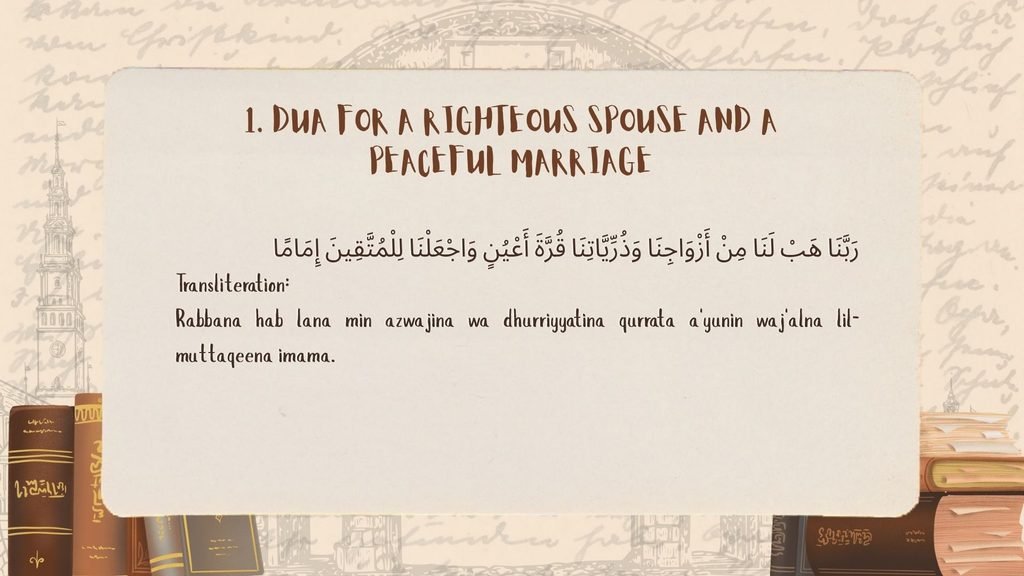
1. Dua for a Righteous Spouse and a Peaceful Marriage
One of the most relevant Qur’anic duas for someone hoping for a blessed marriage is found in Surah Al-Furqan 25:74:
Arabic:
رَبَّنَا هَبْ لَنَا مِنْ أَزْوَاجِنَا وَذُرِّيَّاتِنَا قُرَّةَ أَعْيُنٍ وَاجْعَلْنَا لِلْمُتَّقِينَ إِمَامًا
Transliteration:
Rabbana hab lana min azwajina wa dhurriyyatina qurrata a’yunin waj’alna lil-muttaqeena imama.
Meaning:
“Our Lord, grant us from among our spouses and offspring comfort to our eyes and make us an example for the righteous.”
Qur’an 25:74 is particularly beautiful because it does not focus only on finding a spouse. It asks for spouses and children who bring comfort and for the person praying to become an example of righteousness. Verse by Verse Quran
How to use this dua
If you hope your current relationship could become a marriage, you can recite this Qur’anic dua while asking Allah to grant you a righteous spouse and a peaceful family life.
Rather than assuming that a particular person is definitely your future spouse, leave the final outcome to Allah.
2. Dua for Guidance and Protection of the Heart
When emotions become strong, it is easy to become attached to an outcome.
The Qur’an gives believers a beautiful prayer:
Arabic:
رَبَّنَا لَا تُزِغْ قُلُوبَنَا بَعْدَ إِذْ هَدَيْتَنَا وَهَبْ لَنَا مِنْ لَدُنْكَ رَحْمَةً إِنَّكَ أَنْتَ الْوَهَّابُ
Transliteration:
Rabbana la tuzigh qulubana ba’da idh hadaytana wa hab lana min ladunka rahmah, innaka antal-Wahhab.
Meaning:
“Our Lord, let not our hearts deviate after You have guided us and grant us mercy from Yourself. Indeed, You are the Bestower.”
This is Qur’an 3:8. Verse by Verse Quran
This dua is especially meaningful when your feelings are strong.
You can ask Allah to protect both you and the person you care about from choices that could pull either of you away from faith.
3. Dua for Whatever Good Allah Has Written for You
Sometimes we become so focused on one person that we forget to ask Allah for goodness itself.
A beautiful Qur’anic supplication appears in the story of Musa (Moses):
Arabic:
رَبِّ إِنِّي لِمَا أَنْزَلْتَ إِلَيَّ مِنْ خَيْرٍ فَقِيرٌ
Transliteration:
Rabbi inni lima anzalta ilayya min khayrin faqir.
Meaning:
“My Lord, indeed I am, for whatever good You would send down to me, in need.”
This is found in Qur’an 28:24. Quranic Arabic Corpus
Notice how broad the dua is.
It does not demand one particular outcome.
It asks Allah for whatever good He chooses to send.
You can use this meaning when praying about marriage:
“O Allah, I am in need of whatever good You send me. If this person is good for me, make the path to marriage easy and halal. If something better is written for me, guide me toward it.”
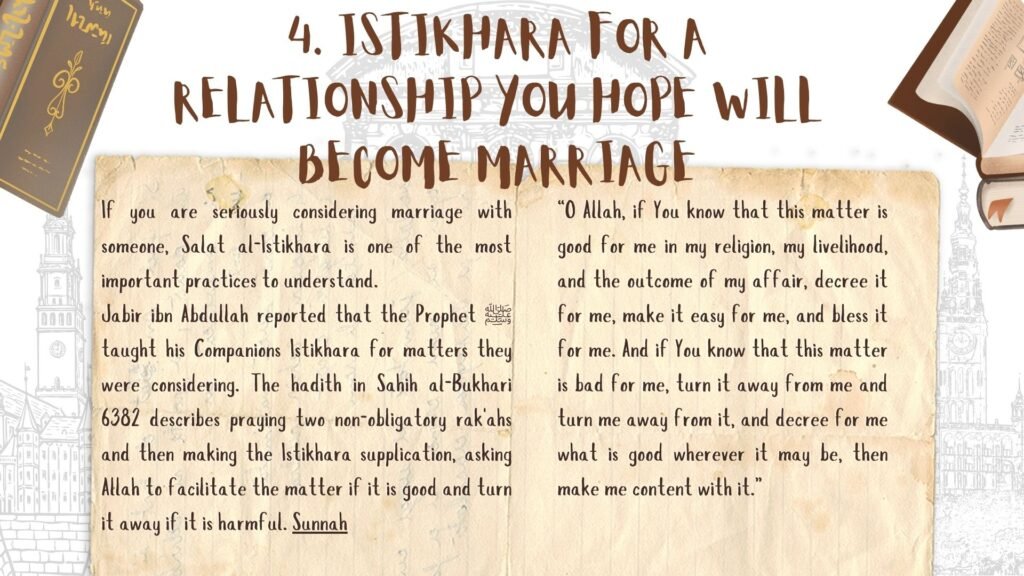
4. Istikhara for a Relationship You Hope Will Become Marriage
If you are seriously considering marriage with someone, Salat al-Istikhara is one of the most important practices to understand.
Jabir ibn Abdullah reported that the Prophet ﷺ taught his Companions Istikhara for matters they were considering. The hadith in Sahih al-Bukhari 6382 describes praying two non-obligatory rak’ahs and then making the Istikhara supplication, asking Allah to facilitate the matter if it is good and turn it away if it is harmful. Sunnah
The essential meaning of the supplication is:
“O Allah, if You know that this matter is good for me in my religion, my livelihood, and the outcome of my affair, decree it for me, make it easy for me, and bless it for me. And if You know that this matter is bad for me, turn it away from me and turn me away from it, and decree for me what is good wherever it may be, then make me content with it.”
When making the dua, you mention the matter you are considering.
For example, you may be asking Allah about whether pursuing marriage with a particular person is good for you.
Does Istikhara guarantee that you will see a dream?
No. The authentic hadith describing Istikhara does not make seeing a dream the condition for knowing the answer. The emphasis is on asking Allah to facilitate what is good and turn away what is harmful. Sunnah
So don’t become anxious because you did not have a dream after praying Istikhara.
5. Dua for a Relationship to Become Halal and Righteous
If you genuinely hope to marry the person you care about, you can make a personal dua in your own language.
For example:
“O Allah, if this person is good for my faith, character, life and future, guide us toward a halal marriage. Help us leave anything that displeases You and make our relationship a source of goodness, faith and peace. If this person is not good for me, protect my heart, give me strength to accept Your decision, and grant me something better.”
This wording is a personal supplication, not a Qur’anic verse or a hadith-prescribed dua.
That distinction matters.
You should not present a newly composed personal prayer as though the Prophet ﷺ specifically taught these exact words.
6. Dua for Protection and Steadfast Faith
A relationship can affect a person’s emotions, priorities and religious practice.
So don’t only ask Allah to protect the relationship.
Ask Him to protect your faith.
You can make the Qur’anic dua from 3:8:
Rabbana la tuzigh qulubana ba’da idh hadaytana wa hab lana min ladunka rahmah, innaka antal-Wahhab.
“Our Lord, let not our hearts deviate after You have guided us and grant us mercy from Yourself. Indeed, You are the Bestower.” Verse by Verse Quran
You can also make a personal prayer such as:
“O Allah, protect us from anything that takes us away from You. Give us wisdom, modesty, patience and good character. If marriage is written for us, help us reach it in a way that pleases You.”
This keeps the focus where it belongs: Allah first, the relationship second.
7. Dua for Allah to Give You What Is Truly Best
Sometimes the hardest part of loving someone is accepting that love alone does not tell us whether the relationship is right for our future.
The Qur’an teaches an important principle in 2:216: people may love something that is ultimately harmful to them, while Allah knows what they do not know. Quranic Arabic Corpus
That makes this a powerful personal dua:
“O Allah, You know what I do not know. If this person is good for me, bring us together through a halal marriage and place blessing in it. If this person is not good for me, remove what is harmful from my path and give me the strength to accept Your decree. Give me what is better for my faith, my life and my future.”
This kind of dua changes the focus from:
“Allah, give me this person.”
to:
“Allah, give me what is best—and if this person is best for me, make the path halal and blessed.”
That is a much healthier way to approach dua when emotions are involved.
Can I Make Dua for a Specific Person to Become My Spouse?
Yes, you can ask Allah for a specific person in your personal dua, while still recognizing that Allah knows what is best.
But don’t treat a dua as a guaranteed formula that forces a particular outcome.
Marriage also involves real-world steps, including mutual willingness, compatibility, family considerations where appropriate, and a genuine path toward marriage. A scholarly answer on this question likewise emphasizes that wanting to marry someone requires taking appropriate means rather than relying on a prescribed formula alone. IslamQA
A balanced dua is therefore:
“O Allah, if he is good for me and I am good for him, bring us together in a halal marriage. Put goodness and blessing in it. If not, turn us both toward what is better.”
What Is the Best Time to Make These Duas?
You can make dua at any time.
You do not need to wait for a special moment before speaking sincerely to Allah.
For important matters, however, you can make your dua during your regular worship and include it in your personal supplication after prayer. If you are considering marriage seriously, Istikhara is particularly relevant because the Prophet ﷺ taught it for matters a person intends to undertake. Sunnah
Most importantly, don’t turn dua into a superstition.
There is no authentic guarantee that repeating a particular phrase a specific number of times will make a particular person marry you.
What If Allah Does Not Give Me the Person I Prayed For?
This may be the most difficult question.
You can sincerely love someone and still discover that the relationship is not what Allah has written for you.
That does not mean your dua was worthless.
The purpose of dua is not to make us control the future.
It is to turn us toward Allah.
Sometimes the answer may be the thing we hoped for. Sometimes circumstances change. And sometimes Allah’s wisdom leads a person away from something they deeply wanted.
The lesson of Qur’an 2:216 is that human desire does not always reveal what is ultimately good for us. Quranic Arabic Corpus
So if the answer is “no,” you can continue asking Allah for peace, guidance and something better.
A Simple Daily Dua for Your Future
If you want one short personal prayer to remember, you can say:
“O Allah, guide me toward what is best for my faith and my future. If the person I love is good for me, bring us together through a halal and blessed marriage. Protect us from what displeases You, strengthen our faith, and place goodness in our future. If this relationship is not good for me, give me the strength to let go and bless me with what is better.”
This is a personal dua, not a narrated Prophetic supplication.
You can say it in English, Urdu, or another language you understand. The important thing is sincerity and the meaning behind your request.
Final Thoughts
When you love someone, it is natural to hope for a future together. But the strongest dua is not one that tries to force a particular outcome.
Ask Allah for guidance before attachment, goodness before possession, and a halal future before a romantic fantasy.
Use Qur’anic duas for righteous spouses and guidance, and use Istikhara when you are genuinely considering an important decision. Qur’an 25:74 asks Allah for comfort and righteousness within marriage and family, while the Istikhara taught in Sahih al-Bukhari places the decision in Allah’s knowledge and asks Him to facilitate what is good. Verse by Verse Quran
And if you love someone, perhaps the most beautiful prayer is simply:
“Ya Allah, if this person is good for me, bring us together in a way that pleases You. And if they are not, give my heart the strength to accept what You know is better.”
FAQs
1. Can I make dua for my boyfriend to become my husband?
You can ask Allah for a specific person to become your spouse, but it is better to make the request conditional on what is good for your faith and future. You can ask Allah to make the relationship halal through marriage if the person is genuinely good for you.
2. Is there a specific Qur’anic dua for marrying someone you love?
There is no Qur’anic verse that specifically says, “Make this particular person marry me.” However, Qur’an 25:74 is a beautiful dua asking Allah for righteous spouses and offspring who bring comfort. Verse by Verse Quran
3. Can I perform Istikhara about someone I want to marry?
Yes. The authentic Istikhara hadith describes asking Allah for guidance regarding a matter you are considering and asking Him to facilitate it if it is good and turn it away if it is harmful. Sunnah
4. Do I have to see a dream after Istikhara?
No. The authentic hadith about Istikhara does not make a dream a requirement. The supplication asks Allah to facilitate what is good and turn away what is harmful. Sunnah
5. Can I make dua for him in my own language?
Yes, you can make personal supplication in a language you understand. Just distinguish your own personal wording from a dua that is specifically narrated from the Qur’an or Sunnah.
6. What if I love someone but I’m not sure whether marriage with him is good for me?
Ask Allah for guidance and consider Istikhara if you are seriously considering marriage. Also look at the person’s character, religious commitment, compatibility and willingness to pursue marriage through an appropriate halal process.