You probably searched this because you want more than a list of verses. Maybe you are a new parent, a grandparent, a teacher, or someone who longs to have children. This article gives you 14 verses, what each one meant when it was written, and what you can do with it this week. We start with the verses that call children a gift, then look at how Jesus treated them, and then at what the Bible says about raising them, including the hard days.
Table of Contents
Toggle1. Children as a Gift: Four Verses About Receiving Them with Thanks
Psalm 127:3-5: A heritage and a reward
This is the best-known verse on the subject. The psalmist says children are a heritage from the Lord and that the fruit of the womb is a reward. He then compares children to arrows in the hands of a warrior, and calls the person with a full quiver blessed.
Most people stop at “heritage” and miss the arrow. An arrow is not kept in a quiver forever. It is shaped, balanced and aimed, and then it is released. A good parent works the same way. You are not raising a child to stay under your control until you are old. You are preparing someone to leave, and to hit something worthwhile when they do.
That matters in both the UK and India, though for different reasons. In many Indian families, a son or daughter’s career, marriage and city are often decided by the whole family together. In British families, the pressure often runs the other way, toward independence at 18 whether the young person is ready or not. The arrow image corrects both. You prepare carefully, and you let go on purpose.
Try this: Write down three strengths you see in each child. Not grades. Strengths, like “notices when someone is left out” or “keeps going when a task is boring.” Then ask what one thing you could do this month to feed one of those strengths.
Genesis 33:5: “The children God has graciously given”
Jacob has spent years running from his brother Esau, whom he cheated. When they finally meet, Esau looks at the family behind him and asks who they are. Jacob answers that they are the children God has graciously given him.
Look at the word “given.” Jacob had been a schemer all his life, someone who took what he wanted. Yet when he speaks about his children, he doesn’t say “I built this” or “I earned this.” He calls them a gift of grace.
That one sentence can change the tone of a home. A child who is treated as a gift hears “I’m glad you exist.” A child who is treated as a project hears “Here is what you still need to fix.” Both parents may love the child equally. The child feels very different things.
Try this: Once a day, tell each child one thing you’re glad about that has nothing to do with their performance. “I like the way you hum when you’re drawing.” “I’m glad you’re in this house.”
Psalm 128:3-4: Children like olive shoots around the table
This psalm paints a picture of a family at a table, with children like young olive shoots around it. Olive trees grow slowly. A new shoot takes years to bear fruit, and the tree it grows into can live for centuries.
The picture is about patience. The writer doesn’t promise quick results. He points to a table, meaning ordinary shared meals, as the place where growth happens.
Consider how much of family life rests on that one habit. A family in Leeds or in Pune that eats together even four evenings a week, without phones on the table, is doing something the psalmist would recognise at once. Nothing dramatic happens at those meals. Over the years, though, children learn to listen, to disagree politely, to tell a story, and to feel that they belong somewhere.
Try this: Choose one meal a week as a protected family meal. No screens, no lectures. Ask each person to share one good thing and one hard thing from the week.

Proverbs 17:6: Grandchildren as a crown
This proverb says grandchildren are the crown of the elderly, and that parents are the glory of their children. It runs in both directions. Old people receive honour through the young, and the young receive honour through the old.
This is a verse worth sharing with grandparents, especially those who live far away. Many families in India have a grandparent in the village and grandchildren in Bengaluru or Dubai. Many British families have the same pattern, with grandparents in one county and grandchildren in another. The distance hurts both sides.
Try this: Schedule a fixed weekly video call, even 15 minutes. Let the grandchild lead it by showing a drawing, reading a page of a book or asking a question about when Grandpa was young. Children who know their grandparents’ stories tend to feel more rooted. That is a gentle observation from ordinary family life, not a guarantee.
2. Made with Purpose: Three Verses About a Child’s Worth
Psalm 139:13-14: Fearfully and wonderfully made
David writes that God formed his inward parts and knit him together in his mother’s womb, and that he is fearfully and wonderfully made.The lasting point here is that a child’s worth does not come from what they achieve. It comes before they have done anything. This is useful for parents of every background, because children now grow up surrounded by comparison. In India, it may be exam ranks and entrance tests. In the UK, it may be grammar school places, social media and GCSE results. Either way, the child can quietly conclude, “I’m only valuable when I win.”A parent can push back on that with ordinary words. When your child returns from an exam, ask “Did you do your honest best, and how are you feeling?” before you ask “What did you score?” The order of the questions teaches the child what you care about most.
Try this: Next time your child feels they have failed, say “Your worth isn’t in this result.” Then help them look at what to learn from it. Both steps matter.
Isaiah 54:13: Taught by the Lord, with great peace
The prophet says all your children will be taught by the Lord, and that their peace will be great.
Notice what the verse does not say. It does not say the children will be taught only by their parents. Parents do their part, but the verse admits there is a teaching that happens beyond the parent’s reach. For anyone who has lain awake worrying about a teenager, that is a quiet comfort. You are not the only teacher, and you are not the last one.
It also does not promise a trouble-free life. It speaks of peace, which is something that can sit inside a person even when life is hard.
Try this: Pray for your child by name each day, even for one minute. Pray for their character and their friends, and not only for their exam results. Keep it short and honest.
1 Samuel 1:27: “For this child I prayed”
Hannah had longed for a child for years and was mocked for it. When her son Samuel was finally born, she said she had prayed for this child, and that the Lord had granted what she asked.
Her story has two halves, and the second half is easy to miss. After weaning Samuel, she brought him to serve at the temple, as she had promised. Her gratitude was not just a feeling. It cost her something.
If you are a parent, you don’t need to give your child away. But Hannah’s story asks a fair question: what does it look like to treat a child as a gift in practice? For many parents it means giving up some of your own time, comfort or career speed so that a child has what they need. That sacrifice is quiet, and the Bible treats it as honourable.
Try this: Think of one thing you could give up this month, such as a hobby evening or a weekend task, so you can give one child your undivided attention.
3. How Jesus Treated Children: Two Passages That Challenge Adults
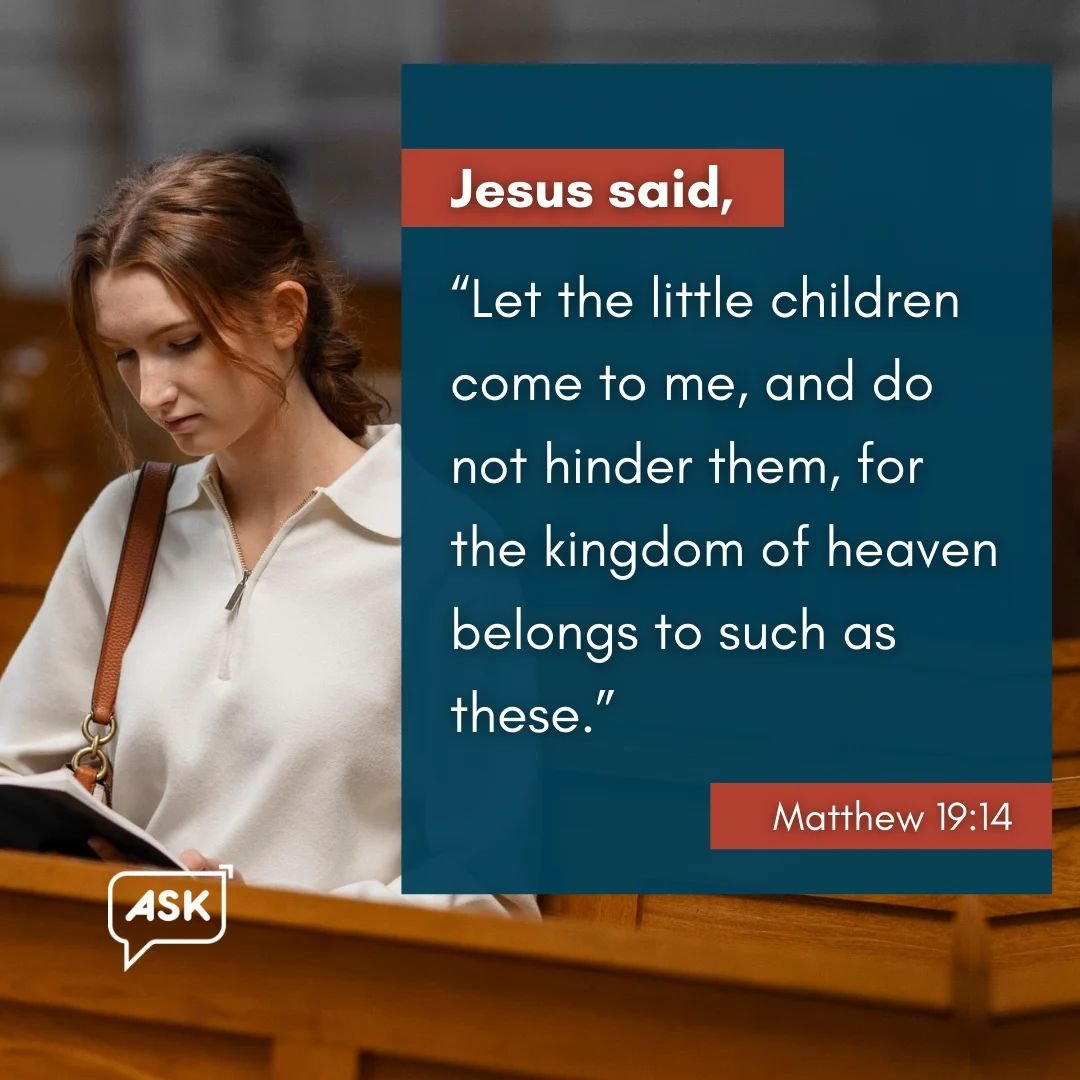
Mark 10:13-16: “Let the little children come to me”
People were bringing children to Jesus so he could touch and bless them. The disciples scolded them. Mark says Jesus was indignant. He told the disciples not to stop the children, said the kingdom of God belongs to people like them, and warned that whoever does not receive it like a child will not enter. Then he took the children in his arms, put his hands on them and blessed them.
First, the disciples were not villains. They were protecting the teacher’s time. Many of us do the same when we say “Not now, I’m busy” to a child who wants five minutes. It feels sensible, and it still sends a message.
Second, Jesus got angry on the children’s behalf. It is one of the few places in the Gospels where he is described that way, and it shows how seriously he took their place.
Third, he held them. A blessing in that passage was physical. He took the children into his arms. Children still understand love most clearly through presence and touch, not speeches.
An illustrative scenario: A father in Manchester works long hours as a delivery driver. He cannot attend every school event. But every night, however tired, he sits on the edge of his daughter’s bed for five minutes and asks about her day. When she is older, she doesn’t remember the events he missed. She remembers the five minutes. That is the sort of blessing this passage points toward.
Matthew 18:2-5 (and verse 6): Becoming like a child
Jesus calls a child over, stands the child among the disciples and says that unless they change and become like children, they will not enter the kingdom of heaven. Whoever welcomes one such child in his name welcomes him. In the next verse he gives a serious warning against causing one of these little ones to stumble.
Most adults read this as a lesson about children. It is also a lesson from them. Children ask questions without embarrassment. They forgive quickly. They trust easily. They don’t pretend to be more than they are.
Adults who live with children can learn those habits back, if we pay attention. When a four-year-old says “Sorry, can we play again?” a few minutes after a quarrel, she is demonstrating something many grown-ups need years of counselling to learn.
The warning in verse 6 matters as well. Children are not only gifts to enjoy. They are people to protect, and the Bible treats harm to them as grave. If you work with children in a school, church or club, this is a good verse to remember when you think about safeguarding rules. Those rules are not red tape. They carry out what Jesus said.
Try this: This week, let your child teach you something, such as a game, a word or how they see a problem. Take it seriously and thank them.
4. Raising Them: Three Verses About the Daily Work of Parenting
Proverbs 22:6: Train up a child
The proverb tells you to train a child in the way they should go, and says that when they are old they will not depart from it.
People often read this as a promise: do the right things and your child will turn out well. Proverbs, though, is a book of wisdom sayings that describe how life usually works. It does not give guarantees. Plenty of faithful parents have children who wander for years. Reading the verse as a contract can crush a parent whose child makes different choices.
A better reading is that training matters, and that early habits go deep. Notice also “the way they should go.” The idea is that training should fit the child’s own make-up. A quiet, thoughtful child and a loud, energetic one do not need identical handling. Good parents watch who the child actually is.
Try this: Make a list of how each of your children differs from the others. Then ask where you are treating them identically when they need different things.
Deuteronomy 6:6-7: Teaching while you live
Moses tells parents to keep God’s words on their hearts, and to teach them diligently to their children. They are to talk about them when sitting at home, when walking along the road, when lying down and when getting up.
The order is important. First the words are on the parent’s heart, and only then do they get passed on. Children are quick to notice if a parent says one thing and does another. The most effective teaching is often unplanned. It happens in the car, over washing-up, at bedtime.
For families in both countries, this is a practical challenge. Many parents feel they must find a special hour for “teaching.” Moses describes something looser. You talk about what matters as life happens. When your child sees someone being treated unfairly on the bus, that is a lesson. When a shopkeeper gives the wrong change, how you respond is a lesson.
Try this: Choose a regular routine, such as the school run or bedtime, and add one short question to it, like “What was kind today?” Keep it simple and keep it going.
Ephesians 6:4: Don’t exasperate your children
Paul tells fathers not to provoke their children to anger, but to bring them up in the discipline and instruction of the Lord. A parallel verse, Colossians 3:21, warns that provoking children risks discouraging them.
Notice that Paul addresses fathers. In his world, fathers held nearly all the authority, and he places a limit on it. Discipline is allowed, but it must not become a way to crush the child.
This verse is a good check for the moment after you shout. Ask yourself whether the child now understands the lesson, or only fears you. If it is the second, something went wrong.
Every parent loses patience sometimes. The helpful response is to go back and repair it. “I raised my voice, and I’m sorry. Let’s talk about what happened.” Children learn more from a parent who apologises well than from one who never admits a mistake.
Try this: The next time you lose your temper, go back within the hour and apologise, then restate the rule calmly. You model both humility and boundaries.
5. Joy, Longing and Hard Days: Two Verses for the Rest of the Story
3 John 1:4: No greater joy
The apostle John writes that he has no greater joy than to hear that his children are walking in the truth.
Note what brings him joy. It is not their success, wealth or status, but their character and faith. For parents, that is a useful reset when the world pushes a different list of goals at your children. You can still want good grades and a good job for them. Just be sure those wishes don’t quietly crowd out the question of what kind of person your child is becoming.
John also says “hear.” Much of a parent’s reward arrives later and from a distance, as a phone call from a grown child, or a letter, or news from a friend. The harvest comes years after the sowing.
Try this: Think about what you most hope to hear about your child in 20 years. Then check whether your daily choices are heading in that direction.
Psalm 113:9: For those who long for children
This verse speaks of God settling the childless woman in her home as a joyful mother of children.
It deserves care. If children are called a blessing, what about people who have none, whether by circumstance, loss or diagnosis? Some articles on this subject skip the question, and that can hurt readers more than it helps.
Here is a more honest way to read it. The Bible does tell stories of people whose longing was answered, like Hannah. It also holds many people whose lives were full of purpose and fruit without biological children. The verse is an assurance of God’s care for those who long, not a formula. If you are in this place, you are not less blessed or less loved. You may also find that spiritual parenting, meaning mentoring, teaching, fostering or being the aunt or uncle who shows up, is a real calling. I would not tell anyone in the middle of grief to hurry toward that idea. Take your time.
For anyone supporting a friend in this situation, avoid saying “just relax” or “it will happen.” Sit with them. Ask what would help.
Try this: If you know a couple who long for children, send a message that says “I’m thinking of you” and expects no update in return.
6. Turning the Verses into a Weekly Rhythm
Verses help most when they become habits. Here is a simple rhythm that suits busy families in either country. Adjust it freely.
Daily (5-10 minutes):
- One specific word of affirmation for each child (Psalm 139, Genesis 33:5)
- A short bedtime check-in or prayer (Isaiah 54:13)
Weekly:
- One protected family meal (Psalm 128:3)
- One call or visit with a grandparent or elder (Proverbs 17:6)
- One moment where a child teaches you something (Matthew 18)
Monthly:
- A one-to-one outing with each child, even just a walk or a cup of chai or hot chocolate (Mark 10)
- A short talk about what’s going well and what to change at home (Ephesians 6:4)
Yearly:
- Write each child a short letter about who they are becoming. Keep it for when they’re older.
A few cautions. Don’t try to do all of it at once. Pick two things and keep them for a month. And don’t treat this list as a measure of whether you are a good parent. It is a set of ideas, not an exam.
Frequently Asked Questions
Which Bible verse is most often used to say children are a blessing?
Psalm 127:3 is the most quoted. It calls children a heritage from the Lord and a reward. Psalm 128:3-4 and Genesis 33:5 are also frequently used.
Does the Bible say a person without children is less blessed?
No. The Bible honours many people who were childless or who waited long years, and it describes God’s care for them, as in Psalm 113:9. Children are described as a gift, but the Bible does not make them the only measure of a person’s worth or blessing.
What does “train up a child in the way he should go” actually mean?
It means that early guidance shapes a person deeply, and that good training takes the child’s own character into account. Most readers understand it as a general principle in Proverbs rather than a guarantee. Parents who did their best are not necessarily at fault if a child later chooses a different path.
How can I teach my children these verses without it feeling forced?
Attach one verse to one routine, such as a short line at breakfast or bedtime. Talk about what it means using a real event from the day. Let children ask questions, even awkward ones. Short and regular works better than long and rare.