
Ruth 2 opens right where so many of us find ourselves at some point starting over in an unfamiliar place, trying to figure out how to survive. After leaving Moab and arriving in Bethlehem, Ruth had already made her choice long before this chapter began. I still get a little emotional reading her words from the first chapter of Ruth, that memory verse in Ruth 1:16-17, where she makes a solemn pledge to Naomi: to stay by her side, to follow her God, and to become one with the Israelites and their society. That kind of action wasn’t small talk; it was a full promise, almost a personal covenant with the God of the Israelites himself. So when the second chapter of Ruth begins, whether you’re reading it in the WEB, NIV, ESV, or GNT, you’re really watching the next step of a journey that started with arrival and adaptation into a completely new life. In this Bible study, I want to slow down and notice how Ruth’s sense of responsibility toward her mother-in-law shapes everything she does next, because this chapter is really about care carried out in daily, practical ways.
What I find so compelling about Ruth’s journey here is how her faith never stayed as just a feeling — it turned into loyalty, commitment, and quiet devotion through obedience and steady service to Naomi’s relationship with her. Having spent years studying Scripture and the Bible through a Christian faith lens, I can tell you this kind of faithfulness isn’t common; it’s the rare, grounded dedication of someone who found belonging far from Moab, in a land that wasn’t originally her own. Her spiritual commitment to worship the God she chose becomes the quiet engine behind her survival, her trust, and her hope for a new life with real purpose. This biblical study of Ruth 2 shows that family isn’t only about blood it’s about the pledge we choose to keep, and the perseverance it takes to keep choosing it every single day.
I always tell people that Bethlehem wasn’t some sprawling city — it was a small town, the kind of place where everyone knew everyone, including Naomi’s relatives. So when Ruth decided to head out to a nearby field to try her hand at gleaning, it wasn’t just chance that led her to land she’d later learn belonged to Boaz, a man connected to her dead father-in-law, Elimelech. As a Moabite herself, fresh out of Moab, Ruth had every reason to feel like a stranger among the reapers working the barley harvest, yet she showed up anyway. Boaz, a prominent landowner, noticed this young lady almost immediately and asked his servant overseeing the workers and employees who she was. What struck me reading Ruth 2:3-7 again recently is how the servant described her — not lazy, never lazy, but genuinely capable, healthy, and hardworking, out since morning despite being a foreigner in a strange land. This opportunity she seized through sheer effort and a positive attitude echoes what Leviticus 19:9-10 commanded about leaving gleanings in the vineyard and grapes and grain for the poor and the foreigner among the Israelites — a built-in provision for survival. Ruth’s daughter-in-law loyalty and sense of responsibility toward Naomi, despite their shared poverty, pushed her into that field of gleaners, hoping simply to find favor. Little did she know Yahweh’s blessing was already unfolding through family, through a relative she hadn’t yet met, turning ordinary labor into the start of something bigger during that barley harvest, exactly as Ruth 1:22 and Ruth 2:1-3 set the scene. Her faithfulness, obedience, and quiet service reflected a commitment rooted in generosity and compassion, and even in hardship she carried herself with real dignity and hope.

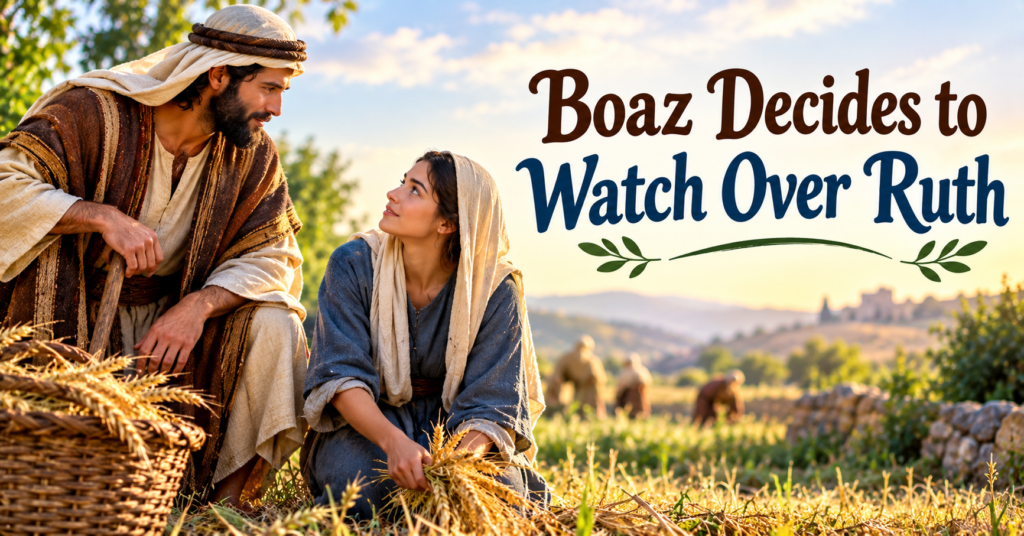
Once Boaz learned who this young woman was, he made a decision that still moves me every time I teach on it — he chose to watch over her himself, offering direct protection and care while she kept gleaning. Fields could be dangerous places for gleaners, even among his own employees, and Boaz clearly understood the ethics of leaving a vulnerable woman exposed to possible attack from men who might abuse their power; an attacker could easily bring disgrace rather than marriage into her story. So he told her plainly to stay close to his maidens, away from the young men, and to drink freely from the water vessels whenever she grew thirsty. Ruth, humbled by this favor shown to a foreigner, gave a bow of genuine humility, calling herself his servant and thanking him for such unexpected kindness and comfort. Boaz explained his reputation for this wasn’t random — he’d heard everything about her character, her hard work, and the dignity she carried since leaving her land of birth, her own people, to follow her mother-in-law into an unfamiliar life near Bethlehem. He spoke of the death of her husband and how she’d left Moab behind, and in Ruth 2:12, that unforgettable memory verse from Scripture, he prayed Yahweh, the God of Israel, would grant her full reward, offering refuge under His wings. Reading Ruth 2:8-13 again, I’m reminded how divine care and human compassion worked together — Boaz gave her real confidence, security, and freedom from indignities, evil, or harassment from male employees, extending respect, gratitude, and lasting safety at the water source, proof of his own noble character as a guardian shaped by deep faith.
By meal time, Boaz’s kindness only grew deeper. He invited Ruth to sit with the reapers, sharing bread dipped in vinegar and handing her parched grain himself until she was fully satisfied — more food than she likely expected from someone outside her social circle. I love picturing this moment during Ruth 2:14-16, because it shows compassion isn’t only about big gestures; sometimes it’s just making sure someone has lunch during harvest season. Then, quietly, he instructed his young men to let her glean even among the sheaves and bundles of grain, deliberately dropping extra leftovers from the harvesters’ own bundles for her to gather and collect. This permission wasn’t loud or showy — it was practical generosity, the kind of provision and support that gave hope to someone disadvantaged and poor. Watching Boaz extend this opportunity to a woman society might’ve overlooked reminds me that real helping often looks like small, steady action: a little extra nourishment, a little more dignity, offered without fanfare during the barley harvest.
By evening, Ruth had gathered nearly an ephah of barley — close to 30 pounds, an astonishing amount of calories that could stretch her and Naomi’s supply for almost two weeks, real foresight born from a full day of hard work and perseverance. When she returned to the city and showed her mother-in-law everything, plus the food left over from lunch, Naomi’s character shifted almost instantly. Hearing it came from Boaz’s field, Naomi immediately recognized his blessing and praised Yahweh for not abandoning His kindness, revealing that Boaz was actually a close relative, a near kinsman, one of their family’s guardian redeemers. That word — kinsman redeemer — carried enormous responsibility, and Naomi’s advice for Ruth to stay near his maidens through both the barley harvest and the wheat harvest was practical care dressed as wisdom. What moves me most reading Ruth 2:17-23 is watching Naomi’s attitude soften — her earlier bitterness and disappointment after losing her husband and children in that foreign land finally begins to change, her heart opening toward hope and healing. Ruth’s loyalty, her original pledge to Naomi’s God, had not been wasted; her commitment as a daughter-in-law despite every reason for abandonment was becoming the very thread of redemption for their family. This is divine providence at its quiet best — Boaz’s kindness, Ruth’s character, and Naomi’s renewed hope weaving together protection, provision, and a future none of them could’ve predicted when Ruth first left Moab for Bethlehem.