
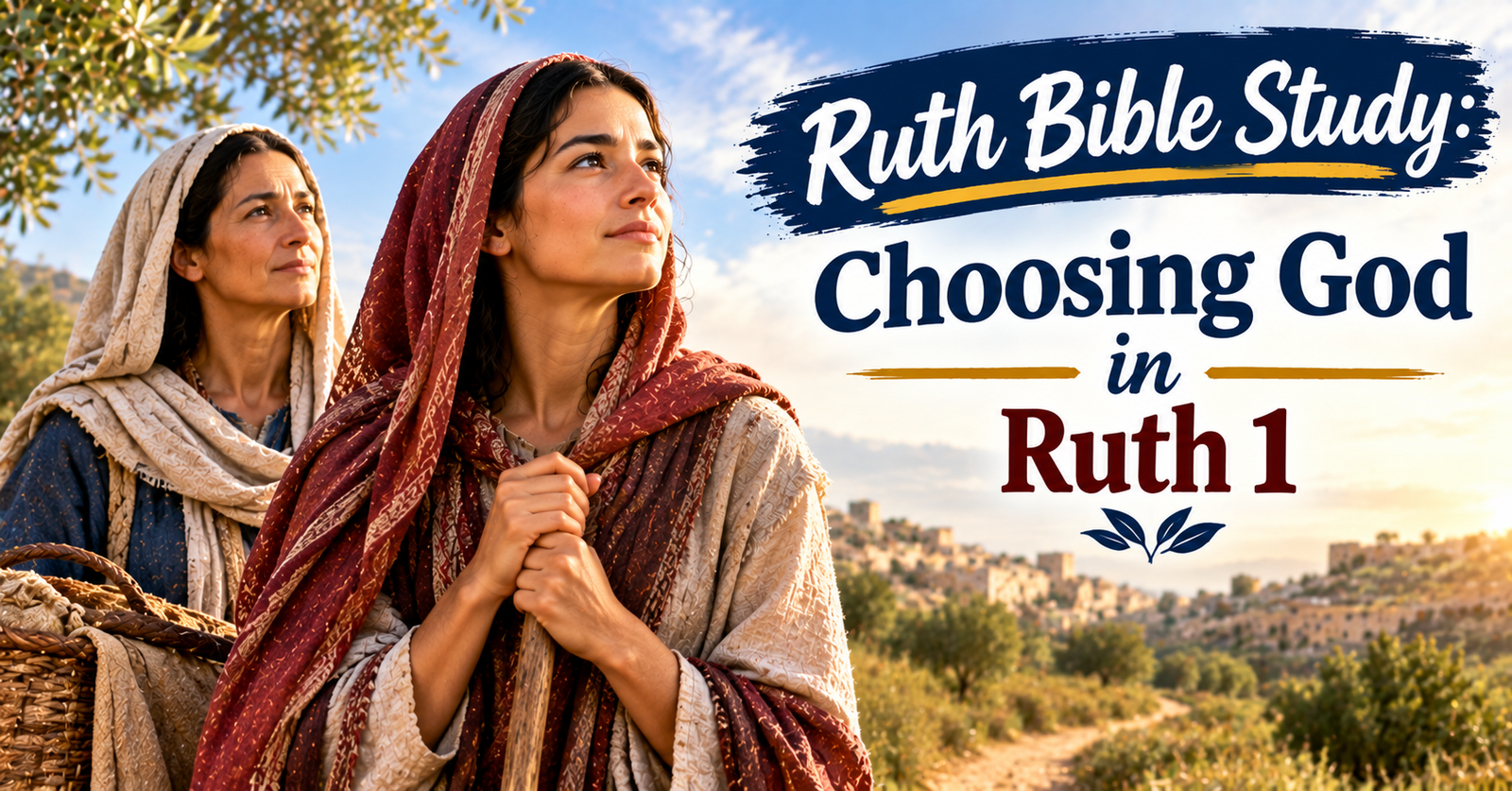
Every time I open my Bible Study Guide to prepare something new for Joyful Moments in Christ, I find myself circling back to the same theme of finding joy not the shallow kind, but the sort that survives difficult circumstances through real persevering faith. That’s exactly what pulled me into the book of Ruth years ago, and it’s why I still love putting together printable discussion questions for anyone studying Ruth 1 for the first time. The first chapter of Ruth introduces us to a young widow standing at the edge of a genuinely difficult decision, one that would define the rest of her life. Born into a Moabite family, worshipping whatever god she grew up with, Ruth suddenly found herself weighing everything against her devotion to her Jewish mother-in-law and the God of the Israelites a Jewish God entirely foreign to her upbringing.
I don’t think we talk enough about how radical Ruth’s choice actually was. She chooses to leave Moab, to travel toward Bethlehem in Judah, and to fully embrace the Israelites and everything Jewish life would require of her. She had every reason to wallow in self-pity, to let bitterness take root after burying her husband, yet she resisted that temptation completely. That kind of strong faith and lasting faithfulness is precisely why Ruth honors such a prominent place in the Bible, and why her choices still anchor countless Ruth 1 discussion questions in churches today. Reading through this Scripture and biblical story again for this Ruth 1 Bible Study, I’m struck by how her perseverance, hope, trust, and obedience flowed naturally into loyalty, commitment, and devotion — every bit of it demanding quiet courage. Her spiritual journey toward God’s honor wasn’t accidental; it was divine providence at work, setting up redemption and blessing through one woman’s faithfulness to God. This early Old Testament moment of spiritual growth is what makes Ruth such an enduring biblical character, and why her Christian faith still challenges mine.
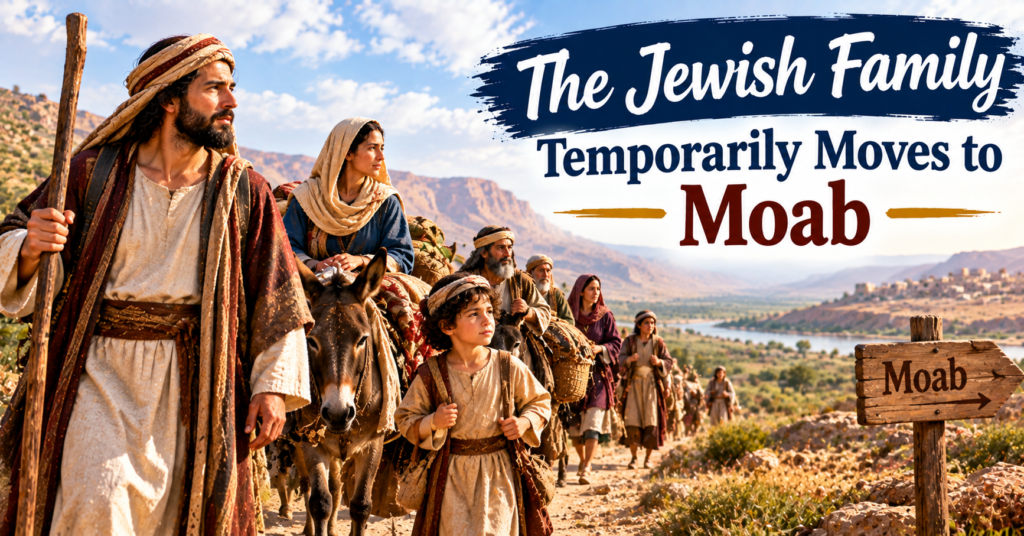
The book of Ruth opens with hardship: food shortages sweeping across the land of Judah force Elimelek to make a hard call for his family. Rather than watch his wife and sons starve, he decides to temporarily move them to Moab, a pagan country far from home. This wasn’t a light decision — I think about it every time I read Ruth 1:1-2, because Elimelek was essentially backed into a corner, weighing the pluses and minuses of raising his two male children, Mahlon and Kilion, among people who followed a different religion than his own religion. He and Naomi left Bethlehem Judah, and the family lived among the Moabites, a Jewish family immersed in Moabite influences and a completely different culture, in a land he didn’t fully trust yet believed his will would reign sovereign over. It felt like a good choice for survival, a choice he’d planned out of love for the Jewish family he was determined to keep together, including a young woman named Ruth who would later step into this same story — even far from his fellow Ephrathites and their home country.
Yet plans rarely stay on script. This temporary living situation in Moab stretched on, and it’s a perfect real-life picture of what James warns about in James 4:13-15 — we make plans for tomorrow, for a year of trade and profit, forgetting that life is but a vapor, here for little time before it vanishes away, and that everything unfolds only if the Lord wills it. Elimelek’s plans went awry, one of the most common occurrences in life, no matter how carefully we try to live wisely. This opening discussion question always gets my study groups talking: how do we hold onto faith, obedience, and trust in God’s providence and divine will when uncertainty and shifting circumstances press against our sense of responsibility? Even this small act of temporary move and protection, driven by family provision, quietly set up the cultural differences and religious differences between Moab and Judah, between Bethlehem and a city that didn’t know their God — a story grounded in Bible and Scripture, worth returning to again and again.
Just as life in Moab found its rhythm, the book of Ruth delivers a drastic change, a sudden change in plans none of them saw coming: Elimelek, Naomi’s husband, dies in this foreign counterpart to Bethlehem, leaving her with two children, her sons Mahlon and Kilion. In time, these two sons grow to marriageable age and get married, taking women of Moab as wives — local Moabite women named Orpah and Ruth — becoming part of this Jewish family through marriage. I’ve always found Ruth 1:3-4a worth pausing on for any discussion question about Naomi’s children, because Scripture leaves us wondering about the different faith these unions crossed. The Bible offers roughly three possibilities: maybe the boys, still young, simply chose whichever right women were nearby; maybe Orpah and Ruth were expected to convert to Judaism and embrace Jewish faith as part of this temporary living situation; or maybe, as verses 1-2 hint, it happened without their father alive to have forbade or asked them to wait for a Jewish husband back in Judah.
Whatever the case, once Elimelek died, Naomi was left largely powerless over her sons’ choice of wives, watching her once-Jewish family bound by marriage to a Moabite family rooted deep in Moab. Some lean toward genuine conversion and devotion to Jewish religion and faith, others toward a more practical interfaith marriage shaped by circumstance rather than family plans. Either way, this cultural setting carried real religious differences, and this kind of faith, tested across lines of ethnicity, exposes real differences in faith and differences in ethnicity that Naomi couldn’t ignore — especially now facing her own widowhood, with father, death, and eventually her sons all behind her, their Jewish identity and Moabite identity tangled together under questions of family authority and parental authority Scripture never fully resolves.
Everything now funnels toward one single choice — really, three separate ones. With Ruth, Naomi, and Orpah all left as widows, each woman faces the same decision: stay rooted in Moab, or make the journey back to Bethlehem in Judah. It’s never just a practical matter of family, marriage, or where to return or stay; it’s a genuinely spiritual choice shaped by faith and religion, by loyalty, commitment, and obedience to whichever God they’d serve. I always tell my study groups this is the most difficult decision in the whole book, because these life circumstances force each woman to choose between the Israelites’ Jewish God and the familiar Moabite gods of home. What follows reveals everything about faithfulness, the real consequences of that choice, and God’s quiet providence working through three very different responses.
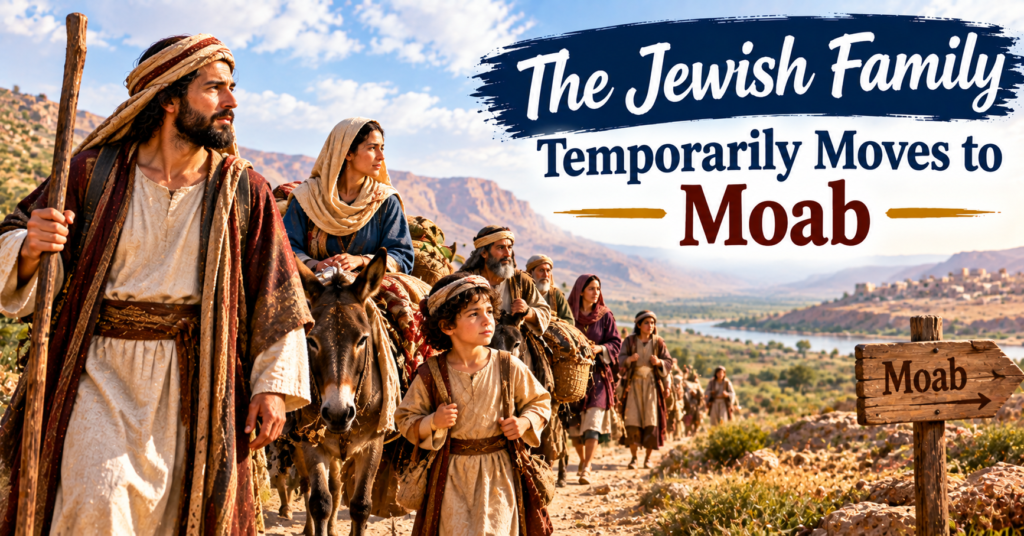
By the time Mahlon and Kilion meet their death, Naomi, Orpah, and Ruth are all widowed, and word reaches them that the famine back home has finally ended. Now comes the real choice: stay on in Moab, or return to Bethlehem after ten years as bereaved women without children or husband. As a discussion question, I often ask why Naomi’s decision was to urge these younger women to stay rather than leave with her — the answer is layered. Naomi has no blood relatives left in Moab, so it holds nothing but dead memories and an original plan long abandoned; she’s set on return home to Bethlehem, Judah, where actual relatives remain. But for Orpah and Ruth, a second marriage to Moabite men, a new Moabite husband, would be far easier to find at home than tied to a foreign mother-in-law carrying a previous marriage into unfamiliar family circles far from close family. Naomi even raises the sobering fact that a Jewish man marrying a Moabite woman, or Jewish men intermarrying across such different religion, was technically forbidden — Scripture warns against intermarry-ing between daughters and sons of the people, since following God while a spouse clings to other gods invited the Lord’s anger and threatened to destroy the family’s footing, which Biblical scholars often trace to Deuteronomy 7:3-4 and this exact passage in Ruth 1:4-9.
What moves me every time is how Naomi frames her blessing: she prays Yahweh will show kindness to these daughters-in-law as they showed kindness to their dead husbands, asking each find rest in the house of husband she’d hope for. She reminds them Yahweh’s own people in the land of Judah finally have bread again, unlike the country of Moab, gently sending them toward their mother’s house. This is provision as much as permission — Naomi wants home, family, and real marriage prospects for these widows, even knowing life as a foreigner caught between Jewish culture and Moabite culture rarely goes smoothly under strict religious law around intermarriage. The faith differences and ethnic differences here carry real spiritual consequences, shaping Naomi’s choice, and soon Ruth’s choice and Orpah’s choice too. Whether it means return to Bethlehem or stay in Moab, each must weigh family support, coming marriage arrangements, and what these women and daughters-in-law truly believe apart from any original plan — a passage full of difficult circumstances, real questions of survival and obedience, and one of the richest turns in Scripture.
After Naomi’s blessing, all three young women weep together, and at first both Orpah and Ruth insist they’ll return with her to Bethlehem rather than stay in Moab among their own Moabite family and people. Naomi pushes back, reminding them she has no more sons to offer as husband material, and urges them home to be near their own daughters. They wept aloud again, and this time Orpah gives her goodbye consent to stay behind while Ruth clings on. I don’t think Orpah’s decision deserves the harsh judgment some give it — from a worldly standpoint, weighing real practical concerns, her choice to return to the gods of home, to the god of the Moabites rather than the God of her dead Jewish husband, made sense. Her Jewish husband was gone, and weighing plain consequences alongside the comfort of simply staying felt safer than the unknown. She’d shown genuine faithfulness to this point, but her belief and worship stayed tied to Moabite religion rather than shifting fully toward the God of the Israelites.
This is where I always slow down for a discussion question on Ruth 1:9b-14: was Orpah’s choice simple wisdom, or a worldly decision with eternal consequences she couldn’t yet see? From a purely worldly perspective, chasing short-term comfort and temporary relief looks like one of the smart choices available, and life back in Moab was more bearable without Naomi’s influence pulling her toward unfamiliar religion. But from a spiritual perspective, this worldly choices logic ignores eternity, heaven, and an eternal perspective — trading faith in God and true belief for short-term decisions risks long-term consequences, even disastrous eternal consequences, since Jewish God and Moabite god were never the same, and only one leads to eternal life. Ruth, by contrast, stayed rooted in sincerity, choosing obedience, hope, and full conversion over lingering bitterness, proving that family, even a mother-in-law’s love, can quietly redirect a whole life toward genuine worship.
While Orpah turned back, Ruth stood determined, refusing every gentle push to leave and stay in Moab instead. Naomi tries once more, urging her sister-in-law to go, to return to her own people and their gods, but Ruth’s insistence only grows stronger. In Middle Eastern culture, a certain amount of polite refusals was expected as an offer of polite manners — the rules of politeness almost required Naomi to push back before accepting, but this wasn’t performance; Ruth’s refusal to leave carried real sincerity and full consent, a genuine insistence born from love, not custom. She’d found something worth more than a return to Moab: a marriage to a Jewish husband, and through him the God of her Jewish husband, that reshaped her whole lifestyle and pulled her from her own Moabite family, the Moabite god, and Moabite religion she’d grown up around, drawing her instead toward the Jewish God.
What Ruth says next is the memory verse I return to more than any other in Scripture: where you go I will go, and where you stay I will stay; your people will be my people and your God my God, my Lord; where you die I will die, and there I will be buried. It’s found in Ruth 1:16-17, and Ruth 1:15-18 as a whole makes for some of my favorite reflection questions in any study — what does separation cost us, and what does loyalty truly require? This wasn’t just commitment, it was full devotion and real courage, a spiritual decision made with eternal consequences in view, choosing the God of the Israelites and true to God living through complete conversion over the safety of home. Her Jewish faith, Ruth’s faith, took root through Naomi’s guidance, shaping a new religious identity and launching a genuine spiritual journey — one shaped by Middle Eastern customs and cultural context, yet driven by her own determination and genuine faith. Naomi’s quiet acceptance of this consent brought Ruth fully into family, no longer just a daughter-in-law but bound to her mother-in-law until death and burial themselves. This eternal perspective, this hope, this lifeline toward eternal life, sprang from simple belief and unwavering faithfulness — exactly why worship of the one true God became Ruth’s whole new faith.
By the time Naomi and Ruth make their arrival in Bethlehem, right at the close of this first chapter of Ruth, the two women walking into town stirred up quite a reaction — the women there exclaimed, barely recognizing her. Naomi tells them to call her Mara instead, because the Almighty has made her life bitter; the Lord sent her out full and brought her back empty, afflicted by misfortune after ten hard years. Coming home from Moab with only her Moabite daughter-in-law at her side, right as the barley harvest was at its beginning, made for a strange kind of return after a ten year absence — no husband, no children, only loss and a Moabite daughter-in-law to show for it, which is why she wanted that name change to Mara, meaning bitter. Whenever I use this as a discussion question, I ask people to sit honestly with her bitterness: was her situation, her displeasure at these circumstances, really self-pity, or simple honesty about desperation and genuinely desperate circumstances? There’s no joy pretending away real sadness and even a touch of anger toward losing both husbands and sons, yet Naomi never blames God, even standing in Judah rather than that pagan land, still choosing to worship her new God with quiet gratitude and restraint, no matter how thin her faith felt in that moment.
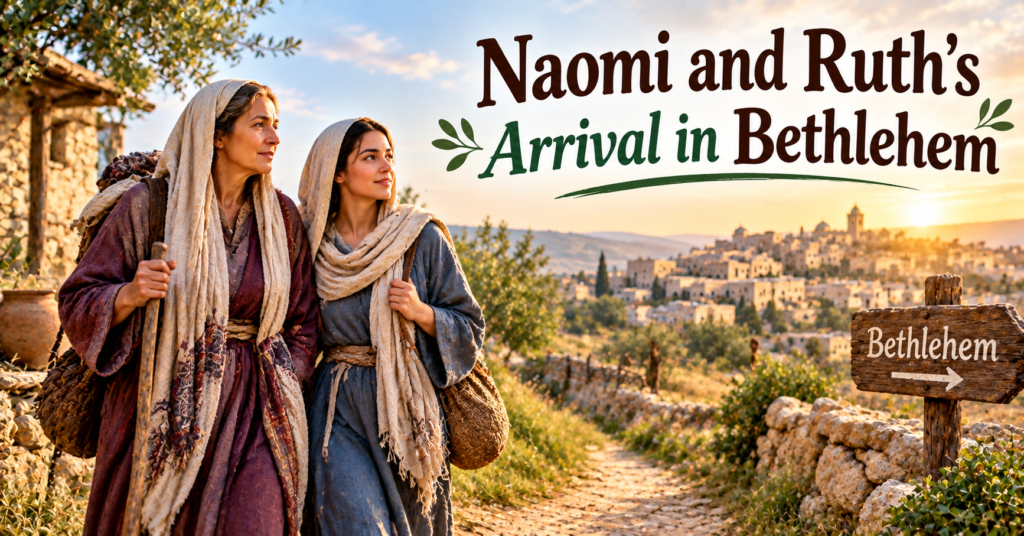
I love telling people this difficult situation isn’t the end — Ruth and Naomi will find real moments of joy ahead. Ruth’s earlier conversion and unshakeable faith eventually bring children, grandchildren, and a husband named Boaz through marriage, and this woman from Moab becomes an ancestor of Jesus’ parents themselves. Difficult situations and hard situations have a way of producing better people, and Naomi’s future, guided by God’s plan, becomes proof of real hope, providence, redemption, and blessing, leading to lasting spiritual growth. Her faithfulness, even through bitterness and self-pity, gave way to a legacy of descendants stretching to Boaz and eventually Jesus, a quiet thread of faith of Jesus’ parents running through this small town. What looked like circumstances built on disappointment, loss, misfortune, and suffering in Ruth 1:19-22 becomes instead a picture of restoration — the barley harvest in Bethlehem, the Moabite daughter-in-law once called Mara, the Almighty and the Lord who never truly left her empty, the affliction that gave way to return and home in Judah rather than pagan land, the worship of a new God met with genuine joy and gratitude. This faith leads to real redemption, perseverance, and a divine providence that shapes Christian faith even now — a spiritual transformation seen only through an eternal perspective, full of hope, blessing, restoration, and a brighter future, no matter how difficult circumstances or hard situations once looked.