
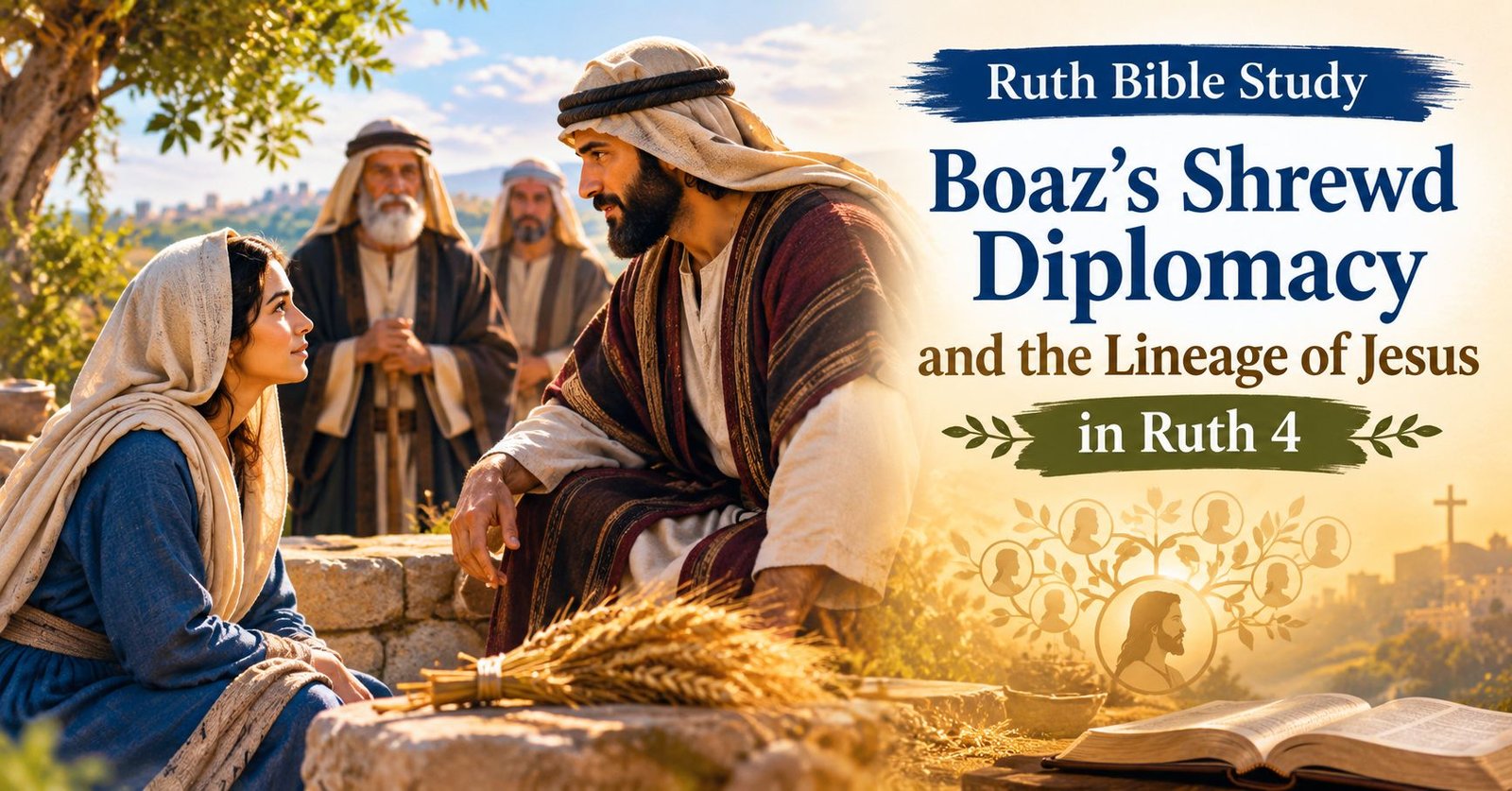
I still remember the first time someone told me that a quiet love story tucked into the Book of Ruth actually connects straight to King David and further still, to Jesus himself. That’s what pulled me into Ruth 4, a chapter that reads like a small-town biblical story but carries enormous weight. At its heart is Boaz, a man whose diplomatic skill turns out to matter just as much as his kindness. His marriage to Ruth isn’t simply a family matter settled quietly among people in a small town; it’s negotiated publicly, deliberately, with real redemption on the line. I’ve always found that detail striking here’s a marriage built out of poverty and insignificance, yet it’s honored in a prominent place for everyone to witness. Comparing translations only deepens that impression for me: the WEB, the NIV, the ESV, and the GNT each render this Scripture slightly differently, but the core of the Bible account never wavers.
What still moves me, no matter how many times I return to this Scripture, is what comes after the wedding. Ruth and Boaz have a child, and that child becomes the grandfather of King David placing Boaz and Ruth directly in the line of Jesus as genuine ancestors. Their descendants stretch across generations until they reach the very lineage of Jesus, which is honestly what makes Ruth 4 so much bigger than a single family‘s happy ending. I approach this chapter now less as an old biblical story and more as proof that redemption doesn’t care about poverty or insignificance it can quietly shape the future of people far beyond one small town.
When I first sat with Ruth 4, it felt like watching a real courtroom drama unfold rather than reading an old Bible story. The book of Ruth builds toward this discussion ever since the third chapter, when Ruth’s proposal to Boaz first set things moving. By the fourth chapter, the final chapter of her story, Boaz’s actions set the scene for a public conversation right at the city gate. He called together ten men from among the elders, plus a near kinsman who was, technically, another man with a higher claim and position than Boaz — the other guardian-redeemer. This was no idle chat; it was a serious conversation built on real duty, the kind of obligation that in Israel’s law traced back to a brother‘s job of keeping a family’s name and land alive. Boaz laid out the case plainly: Elimelech, Naomi‘s late husband, had left a parcel of land behind before the family fled to the country of Moab, and since there was no one to redeem it, someone had to buy it back for the people watching at the gate. Tucked into that meeting over Naomi’s poverty sat a clause nobody expected, almost a promise of its own: whoever agreed to redeem the land also had to marry Ruth.
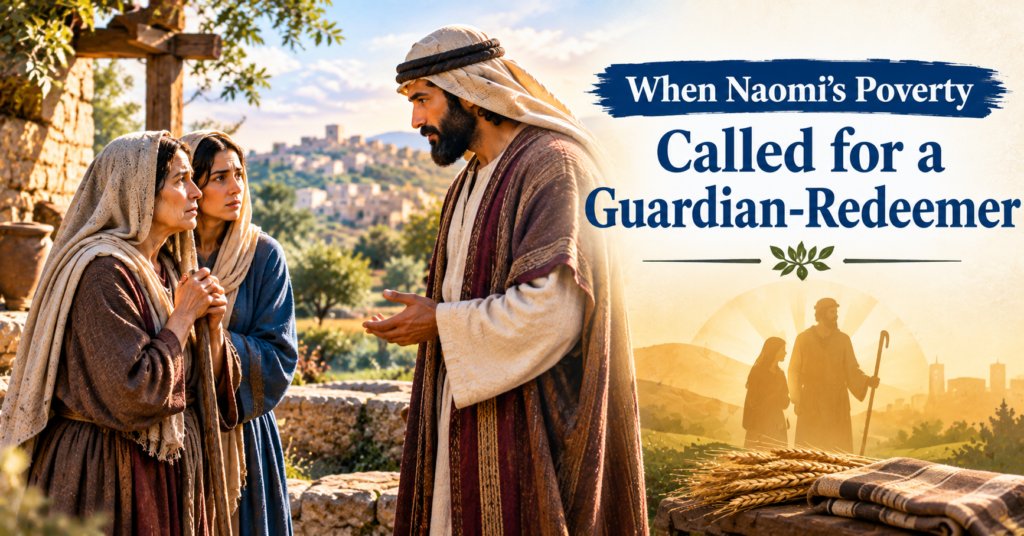
What still gets me every time I read this issue is how genuinely torn the other man seemed. He seemed willing to redeem the land and said he’d help, no problem, until Boaz mentioned that this proposal, this marriage, this whole redemption, meant marrying Ruth too. Right there, he began trying to find a way out, afraid that marrying Ruth would threaten his own land, possession, and future claim. That single condition became the key advantage of the whole proposed marriage: whoever took on the responsibility of fulfilling guardian-redeemer duty gained access to additional land and a real claim to the land, but only by also accepting the rescue of Naomi from poverty and fulfilling the duty of marrying Ruth. Faced with that trade-off, the other guardian-redeemer stepped aside as a backup guardian-redeemer, leaving Boaz as the rightful kinsman-redeemer in front of his friend and the ten town elders. Right there at the gate, Boaz fulfilled his promise, rescuing Naomi, and bringing a serious resolution to a case that once had no easy answer among any of the potential guardian-redeemers.
I’ve always admired how Boaz handled that gate meeting, because his response was so intended and calculated without ever feeling cruel to the other man. Before asking the backup guardian-redeemer to buy the field from the hand of Naomi, Boaz let him say yes first, and only after that did he mention that taking the field also meant he’d have to marry Ruth — Ruth the Moabitess, the wife of the dead, in order to raise up the name of her first marriage on his own inheritance. That single detail changed everything for the other man. He had to quickly consider the implications of marriage to a foreign woman, weighing the risk of taking a second wife whose children might complicate inheritance, land, and ownership claims among his original family members. Rather than looking selfish by refusing outright, he could now decline the responsibility for a perfectly honorable reason: doing so might endanger his own inheritance and create problems for his existing descendants from his first marriage. Watching this unfold, I think Boaz knew exactly what he was doing — this is shrewd diplomacy in its purest form, giving a struggling man a face-saving way to decline without looking like a detractor of Naomi or her family.
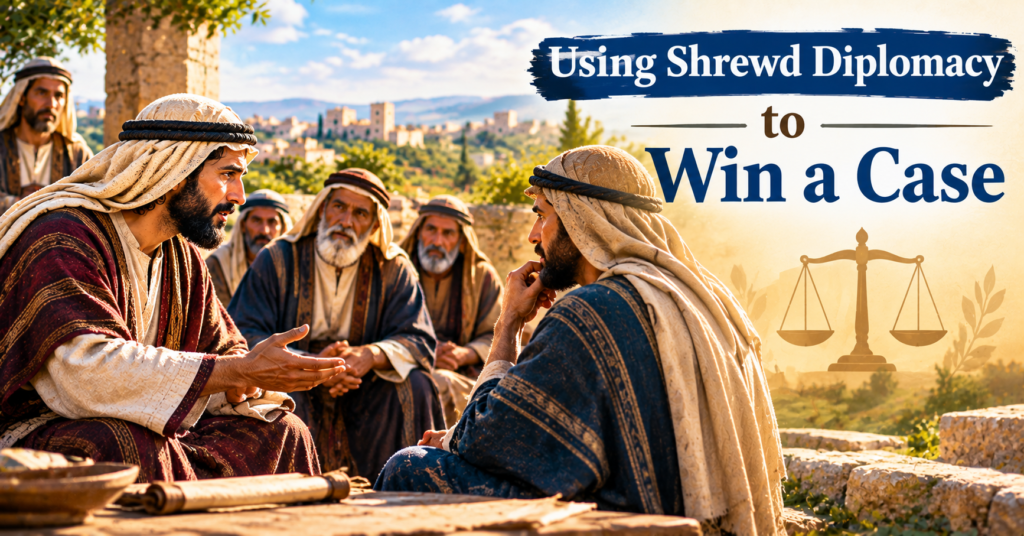
What strikes me most is how this whole exchange became a genuine win-win. The other man could pass the duty, and thus pass the land, to someone else without shame, while Boaz, who’d clearly shown through his few interactions with Ruth that he was willing to take a risk and fully fulfill that duty, could step into the obligation to marry her with respectable witnesses watching. The right of redemption now rested entirely on Boaz’s head — or rather, since the other man removed his sandal, it passed cleanly onto Boaz’s shoulders as the true guardian-redeemer, freeing him to redeem the land, care for Naomi’s poverty, and secure a grandchild for the original family name. In front of those witnesses, present at that historic scene, no one’s descendants were left in jeopardy, and every possibility for Naomi’s descendants to be cared for moved forward through this quiet, dignified pursuit rather than open redemption, leaving no room for any other woman or rival pursuit to interfere with what Boaz had set out to do.
There’s a strange Jewish custom tucked into this part of Ruth that I find oddly touching once you understand what’s happening. Back then, land dispute and thorny issue proceedings weren’t settled with paperwork; instead, a near kinsman would pull off his sandal and hand it over as a way of formalizing transactions in front of witnesses. This sandal exchange was simply how Israel handled exchanging rights openly, giving proof that a deal was sealed honestly, without anyone getting cheated or accused of having stole something later. So when the other party removed his sandal at the gate, it wasn’t awkward at all it was actually an honorably conducted, publicly recognized way of honoring an agreement, watched by the elders as official witnesses to the whole approach Boaz took toward this life altering problem. I’ve come to see this custom as God’s quiet way of making sure no land ownership could ever be purchased in secret, protecting families from silent possession grabs without permission.
Once the sandal changed hands, Boaz stood before everyone and declared that he had now redeeming the inheritance left by Elimelech, Chilion, and Mahlon men whose name among their brothers would have vanished from the house of Israel had no one stepped in for the dead. He also announced he would take Ruth the Moabitess as his wife, a young woman far from home, so her husband’s name wouldn’t be lost from his place and people. The elders responded with a beautiful blessing, praying that Yahweh would make Ruth like Rachel and Leah, the very women who built up the house of Israel, and that Boaz would be famous in Ephrathah and Bethlehem. Looking back at how this marriage later produced Perez through Tamar and Judah, connecting straight through to offspring who carry some of the most famous names in the whole Bible, I can’t help but feel these ancient negotiations were never just about land at all they were successful, God-guided steps in a much bigger story only God could have written.
What moves me most about this ending is how quickly grief turns into blessing. Once the marriage was settled and the land redeemed, Yahweh allowed Ruth to conceive, and she gave birth to a son — a moment that restored Naomi‘s prominence in her community after years of loss. The women of the town gathered around Naomi, telling her that Boaz had proven himself a true near kinsman and restorer of her life, someone who would sustain her in her old age. I love that they called Ruth, her daughter-in-law, someone who loves her more than seven sons could — that’s high praise in a patriarchal society where sons were everything. It echoes what’s said of her earlier in Ruth 3:11, that she’s a faithful woman of noble character, a kind of living testament to what real character and faith look like even as a foreign daughter-in-law with no guaranteed place among the people.
I’ve studied enough Bible genealogies to know how rare it is for women to be named at all, yet here Naomi takes the child, Obed, to her bosom as his nurse, and the neighbors give him a name, tying him permanently into Israel’s history. That boy becomes the father of Jesse, who fathers David, planting Ruth firmly in the line of David and, generations later, the line of Jesus himself. Tracing the generations from Perez to Hezron, Ram, Amminadab, Nahshon, Salmon, and Boaz, all the way to Jesus through Mary and Joseph, I’m reminded that ordinary faithfulness, not lesser character or lesser faith, is what God uses to shape future generations. It’s a personal reminder to me that strong faith has real impact — the character and faith we live out today really can pass onto our children and grandchildren, especially when we interact regularly and faithfully with the famous and the forgotten alike within our own community.