

When I first started my dive into the book of Acts, I wanted to know more about the man behind it. Luke is best known as the author of Acts and author of the Gospel the Gospel According to Luke, to be exact and learning about him honestly changed how I read the New Testament. Most readers move through Acts of the Apostles without ever asking who actually picked up the pen. Luke the doctor was that man, a trained physician who became a close companion to Paul on his travels. As a Gentile, or more precisely a Hellenistic Jew, he wasn’t a typical Jew raised strictly within Jewish tradition; his outlook was shaped by both Hellenistic culture and Greek thinking, and that blend colors the way he tells the story of early Christianity.

Here’s where it gets interesting. Most people assume Paul the author wrote every letter under his name, including Hebrews. But other people, plenty of scholars among them, believe the author of Hebrews may actually have been Luke himself. If that’s true, written by Luke could apply to far more scripture than we usually credit him for. I find that possibility fascinating it turns a quiet companion into one of the most influential biblical authors of the entire New Testament, alongside other biblical books shaped by Jewish memory and Greek style. As I continue this series and look deeper into the Apostles, their journeys, and the Gospel message they carried, remember: the person telling the story matters just as much as the story itself.
I’ve always found it striking that a physician ended up writing so much of the New Testament wait, that’s not in this list, let me stick to your words. What draws me to Luke isn’t just that he followed Jesus, but that he brought a physician‘s eye to everything he recorded. He wasn’t one of the original twelve who walked alongside Jesus during His earthly ministry, yet he became one of the most trusted followers chronicling the faith. His Scripture reads differently than the other religious writings of his time — there’s a careful, almost clinical attention to detail in his healing accounts that only someone trained in medicine would notice. I think that’s what makes him such a compelling voice among Bible authors: he wasn’t just retelling stories he’d heard secondhand from other people; he approached his writing with the mindset of someone doing real academic research.

What really stands out to me is how educated Luke actually was. He moved comfortably between languages his grasp of Greek was polished, and many scholars believe he understood Aramaic well enough to work directly from earlier sources, which tells you a lot about his knowledge and training. Paul himself confirms this physician‘s identity in Colossians, mentioning Luke by name alongside Demas as one of his companions in ministry. That single reference in Colossians has always fascinated me — it’s a small, human detail buried in a letter, yet it anchors everything we know about who Luke really was: a doctor, a scholar, and one of the most careful religious minds to ever put pen to page for the sake of the followers who’d come after him.
Something I always point out when people ask me about Luke is that he wasn’t just a name attached to a book he was a genuine travel companion to Paul, and you can actually track the moment he joins the story. Right around Acts 16, the narration quietly shifts from “they” to “we,” and that small pronoun change is huge; it means Luke was physically present for what happened next. Paul had a vision calling him toward Macedonia, sensing the Lord had called him to preach the Good News there, and from that point on, Luke the companion stayed on the journey with him. I find that detail so grounding this isn’t secondhand preaching passed down through rumor; it’s an eyewitness account woven into the historical record. That’s part of why I trust the authenticity of the book of Acts so much: when you have verification through direct eyewitness presence, the events described carry a different weight, free from the kind of errors that creep into stories told at a distance. The wider biblical account of Acts covers Luke‘s travel and ministry alongside Paul, building up the early Christianity movement one town, one group of believers, one gathering of brothers at a time all by the grace of God and no small amount of courage.
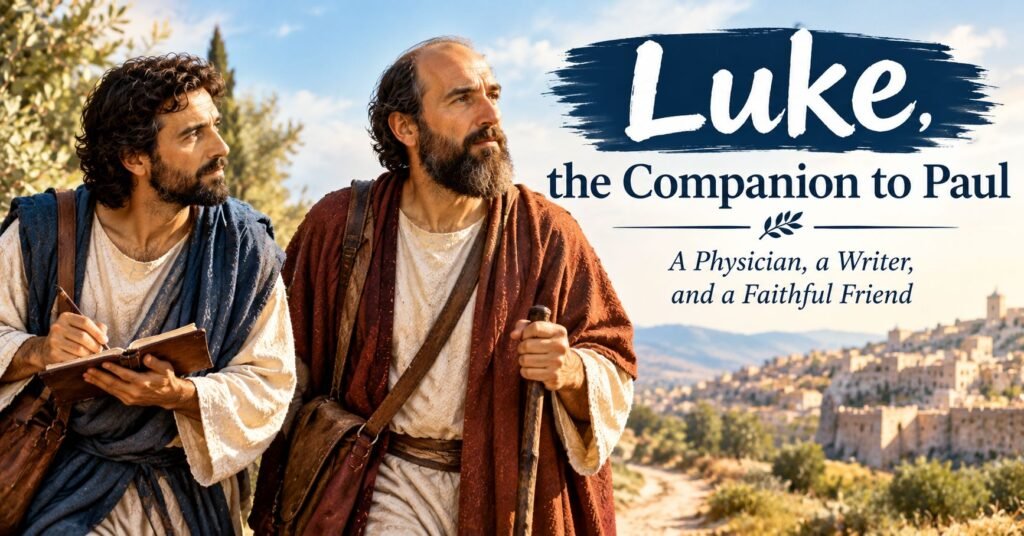
By the time we reach Acts 28, Luke‘s arrival in Rome is still tied to Paul, and I think that loyalty deserves to be honored. They sailed on a ship out of Alexandria, having wintered on an island under the sign of the Twin Brothers, and the route reads almost like a travel diary: Syracuse for three days, then Rhegium, on to Puteoli, roughly seven days in total, until believers met them at the Market of Appius and Three Taverns a moment where Paul reportedly thanked God for the welcome. Through it all, a centurion kept watch over the prisoners, answering to the captain of the guard, with a soldier assigned to guard Paul even as his activities continued. I’ve always felt that this stretch of the historical account shows Luke at his best not a distant editor, but someone who walked every mile of it himself.
This is the question I get asked most whenever I talk about Luke: was he a Gentile, a Hellenistic Jew, or a Religious Jew? Honestly, after digging into it myself, I don’t think there’s one clean answer and that uncertainty is part of what makes him so interesting. Some scholars lean toward non-Jewish origins, pointing out he was likely uncircumcised, meaning he didn’t grow up practicing the Jewish religion the way a Jewish person raised under strict circumcision customs would have. Others argue he absorbed enough of Greek culture and Greek ways of life to be classified among the Hellenistic Jews — someone shaped by both worlds, moving between Judaism and Christianity without fully belonging to either camp in the traditional sense. I lean toward the view that his Jewish identity, if he had one at all, was more about cultural identity than strict religion, and that ambiguity itself tells us something about how fluid religious identity could be in the early church.

One clue I find genuinely compelling comes straight from Scripture. In his letter to the Colossian church, Paul greets a whole list of names Aristarchus, Mark, Justus, Barnabas, Epaphras, and Demas — but he separates them by group: some are described through circumcision language as fellow workers for God’s Kingdom, while others, including a beloved physician, are set apart as if they weren’t part of that circumcised group at all. That physician, most read as Luke, appears in Colossians as a fellow prisoner alongside Paul, a true servant of Christ devoted to prayers and the will of God, showing real zeal for churches in Laodicea and Hierapolis. Compare that with Romans 16, where Paul names actual relatives like Jason, Sosipater, and mentions Timothy and Luke’s name is nowhere among them, which many take as further historical evidence pointing toward Gentile roots. Both the NIV and ESV translations preserve this same biblical text, and even his name carries clues: Loukas in Greek, rendered Lucas or Lucius in Latin name form, sits among a cluster of Gentile names rather than typical Roman or strictly Jewish ones. His Gospel, the Gospel According to Luke, was written in Greek, his clearly favored language, and scholars studying the Greek language against Aramaic as a primary language often treat this as one more thread of circumstantial evidence. None of it proves anything outright about his conversion after Jesus’ ascension, whether he came to follow Jesus as one of the early followers or simply joined disciples already gathered into the church, building the Christian faith documented across the New Testament. But between the textual evidence, the first part of his writing style, and small variations in reference that read almost like afterthoughts, I’ve come to see the authenticity of his story less as a settled fact and more as an open, fascinating possibility and honestly, I think that’s exactly how early Christianity itself often worked.
Here’s the puzzle that keeps pulling me back into Bible Study every time I revisit Luke: was he a Gentile, a religious Jew, or an uncircumcised Hellenic Jew? The Gospel of Luke carries real authority as an eyewitness account, yet Luke’s Gospel never says outright whether he counted himself among the 72 disciples sometimes called the seventy others the Lord sent ahead into every city and place or whether he simply arrived later, after Jesus’ ministry had already ended. By the time Pentecost happened in Acts 1, roughly 120 believers, or one hundred twenty as some translations put it, were gathered together, and Peter stood among the disciples as early Christianity took shape. I’ve always found it strange that a gospel this published, this trusted, leaves the identity of its own author so open. Was he a Hellenistic Jew shaped by both worlds, or truly one of the gentiles looking in from outside?

What makes this even messier, in my opinion, is tracing Luke through Paul’s testimony and his own conversion story. Paul, once a Pharisee devoted to religion before his conversion, later gathered training and had countless conversations with the original apostles and Hellenistic Jews in Jerusalem, and even preached the road to Damascus himself. Somewhere in that stretch through Barnabas, through preaching among the Hellenists in Caesarea and Tarsus Luke appears as a close companion, an educated doctor whose investigative gospel reads like genuine research built on eyewitness events and eye witness facts, not distant rumor. He wasn’t one of the original apostles, yet his association with Jesus’ ministry through Paul and Barnabas as a travel companion gave the Gospel of Luke a place among the three gospels written closest to the events themselves. Paul even calls him fellow-worker and beloved physician in Philemon and Colossians, small Bible verses that quietly confirm who Luke really was. It’s exactly this kind of tension sitting with Acts, the Ascension, and the wider book of Acts that I love unpacking here on Joyful Moments in Christ, one of the many Bible Studies and Musings I keep coming back to.